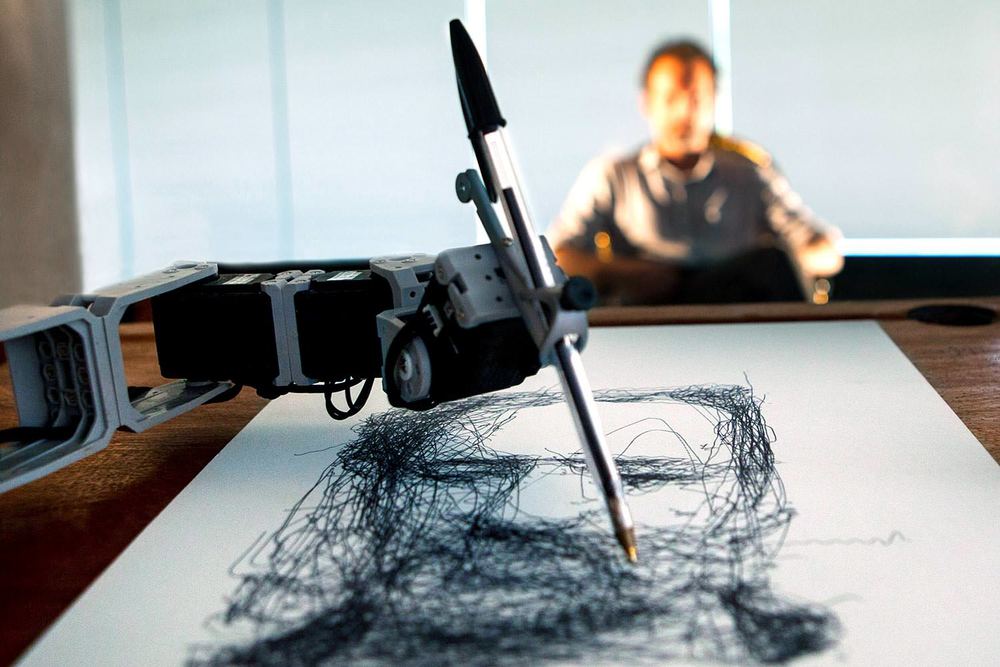
A Mind on the Razor’s Edge

WARNING: The following post addresses self-harm, and all that implies. Know yourself before you come to know what’s next.

WARNING: The above picture is also a graphic picture of a real brain. But I think I might be a little late to inform you…Sorry ’bout that.

With formalities out of the way, let’s talk about happiness. Happiness, as a broad term that we will simply define as the perceived absence of pain in a human being’s life, can be many different things. A feeling, a motivation, a goal, a reason, a guarantee; howsoever you perceive happiness will have a large impact on the way you view life as a whole.

James Hughes believes that happiness, an “illusive goal,” is becoming easier than ever to attain as “medical technology is…freeing us from the discomforts of mental and physical illnesses” and “new pharmaceuticals and nanotechnologies will permit us happiness and freedom from pain that are currently unimaginable” (Hughes 43). A fine dream, though rather unrealistic for an Earth populated by diverse minds. However, there is still something here that might be practical, specifically if we consider Hughes’ goal impossible for posthuman pursuits. What if it was much simpler than such a complex abstraction as happiness? Say,


“Our most fundamental drive in life is to be happy, to reduce our pains and increase our joy and fulfillment. It seems obvious that the ethical goal for society should be to make life as fantastic for as many people as possible, not to valorize pain and suffering” (Hughes 44).

Hughes, James. “Being Happier.” Citizen Cyborg: why democratic societies must respond to the redesigned human of the future. Cambridge, MA: Westview Press, 2004. 43-52

Looking at suicide rates across the globe, it is safe to say that the majority of individuals are able to live their lives. They may not be happy, but they can live, and typically do so in a manner that is, if not succeeding, at least directed down a path that will afford them some sort of happiness. No matter how fleeting, no matter how false. But that’s the problem with happiness; it is manufactured, and can never really last unless it is quickly replenished by external forces. Therefore, I suggest we leave this group of people alone, your average man, as someone who can control his feeling well enough to keep on living.

I am more concerned with he who cannot keep living, those who valorize pain and suffering, whose motivator is not happiness and resist most attempts to correct this error. It is an error. Philosophically, and greatly depending on the individual’s personal convictions, I do not think those who wish to kill themselves are wrong to wish so. Quite natural, actually. It is the drawing out of such a process, the depression, the abject sadness, the bitterness, the aimlessness, and, worst of all, the flagellation that is the error.


“Fear appears as an essential presence in the asylum…But these terrors surrounded madness from the outside, marking the boundary of reason and unreason, and enjoying a double power: over the violence of fury in order to contain it, and over reason itself to hold it at a distance; such fear was entirely on the surface” (Foucault 144).

Foucault, Michel. “The Birth of the Asylum.” The Foucault Reader. Ed. Paul Rabinow. New York: Pantheon Books, 1985. 141-167

The madness, I think, is continuing to live in unhappiness despite desperately wanting to die. That is the unreason and the reason, and continuing to practice unreason leads to the failed attempts at suicide, the cuttings and so forth. That holds the fear of death at bay, and, oddly enough, makes the one conflicted by “madness” feel all the more alive.

What is the solution? I cannot shrug and flatly say “Hurry up and get it over with”; personally knowing someone who has been affected by this “madness” prevents me from such a cruel damning of humankind’s desire to survive. But that, I think, is the counter to Hughes’ assertion that we all strive to be happy. No, I say, it is far more basic. We all strive to live.

Those who are moderately happy, or at least distract themselves well enough, can live without medicinal enhancement. Let’s leave them to their own devices. Instead, how might we treat the deeply depressed? Not the one who laughs their fake laugh about how miserable they are and then forgets about it in bed with her boyfriend, but the one who can barely function because they’re so bogged down by overwhelming emotions?

The drug I have in mind would function in a similar fashion to the “A Pill” in Cary Joji Fukunama’s Maniac. Annie Landsberg uses it frequently in episodes one and two, revealing in episode three that it is so she can relive the worst experience of her life, her sister’s death. And yet, it is also the best experience, because she can spend an entire day with her sister, over and over again. It makes her feel alive…or, at least, okay with being alive. Her character is active, not depressed in her actions, though perhaps aimless in her wants, and not self-harming in the slightest unless you count her addiction to that pill.

Now, reliving your worst moments is not exactly the type of pill I’m suggesting, nor is it Hugh’s bliss pill. Mine is a mere “satisfaction” pill, to satiate the desires pent up in the mind by the individual inclined to self-harm. In feeling only, of course; we are opening wide the gates of the mind’s asylum, but shooting down the inmates before they reach society. The patient will feel alive, but they will not hurt themselves, like satisfying a lust with pornography instead of actual sex. Desire, even with such consequences as cutting, is still only a surface-level motivation, and I think it is feasible to meet the need without performing the action. Even a smoker can be satisfied without smoking by wearing a nicotine patch.

However, like pornography and nicotine, my proposed alternative could still pose psychological consequences. There is no telling what emotional numbness this pill could cause in the patient, though Annie seemed less emotional before taking her “A Pill.” It could greatly affect emotional responsiveness, in that empathetic and sympathetic reactions would be greatly reduced. But is the posthuman world one in which all emotions are realized, or where emotion is unnecessary and inconsequential? If it is the latter, then it can be solved with the “Satisfaction Pill,” because then at least the individual would be able to function in social environments without depressive inhibitors. Yes, sometimes we just need to learn to be satisfied with the best we can do, and maybe we wouldn’t be so disappointed. Or unhappy, as Hughes would impress.


Transitions

This blog post is a little different from the rest, its purpose being a declaration for my “Posthuman Rhetoric” college course. Just so you know, otherwise you’ll have no idea what’s going on should you choose to continue reading.

My project is a bit tricky. On the one hand, I want to use Prezi for it’s ability to create a web of connections; on the other hand, I want to use Weebly to create a board that can continue to accept additions without any end in sight. As I go forward in my explanation of what it is, you’ll probably understand why I lean towards the Weebly.

The subject of study is transition. If you’ve read my Undergraduate thesis paper, about how transitions in linguistic myth create social upheaval as observed in the works of Dostoevsky, you’d think I have a bit of a soft spot for transitions. Indeed, I always want to know how one gets from point A to point B, or why point B is rejected for point C, and every little interconnection you could chart. And so I continue with that theme, but with new points: how does one transition from humanism to posthumanism?

It is quite open-ended, I know, but I would be cheating you if I told you I knew where I would end up. It is the type of project I don’t think could end, because man really is a fickle creature. There are aspects of posthumanism easily accepted, and aspects just as easily rejected. Sometimes ideas of posthumanism are accepted without the individual knowing what it really means, what they are gaining, what they are giving up. Each section of the Weebly is its own extensive close-study of an artifact, and how it exemplifies a certain pathway from humanism and posthumanism with mankind’s reactions therein, explored through use in popular media.

Here are some examples. One section will talk about the perception of human utility and function from both sides, and bring in Ayn Rand’s “Atlas Shrugged” for study as well as studies of machines taking over human labor. Another section will question the difference between life in artificial reality and life in material reality, their worth, and why so many players in the anime “Sword Art Online” committed suicide as soon as they realized they realized they were trapped in a game. Another section might then question the connection between collective morality and personal enjoyment while exploring the three vastly different endings of Toby Fox’s “Undertale.” My research articles will also vary each post, using such articles as have been provided us by Pepperell, Hallenbeck, and Edbauer, but I shall also do some external digging for the more outlandish considerations and include videos or photos where they are beneficial in understanding such complex topics. I do not have a specific number in mind for posts, but it is for my own benefit as well as for the grade, so I will let Professor Read-Davidson dictate that little detail.

What I do want to limit this to is researching artifacts of popular media. Popular media is the indication of how culture changes, and can be marked in revenue or following, and thereby give us a good idea of what is appealing or becoming acceptable. Charting the transition points along the line between humanism and posthumanism can, like shifts in linguistic myth, give us a rough but workable prediction of where the collective philosophy is going. Or, perhaps, what might keep it from reaching its end goal, whether that be humanism or posthumanism. Once I feel I have enough data, I shall create a final section in which the map of the collective philosophy is explained, at least according to hypotheses from where we have been and where we are now, both in reality and artificial reality.

If you would like to know if I at least have an idea where I will be by the end, I will admit this much: I have a strong suspicion that escapism is a key tenet to the construction of posthumanism. Whether or not the artifacts, besides being methods of escapism in their very nature, lend themselves to this interpretation, and whether that interpretation is inherently positive or negative, remains to be seen. At least until the research concludes.

Power Hungry

The essence of power is the ability to influence or control. In the realm of our personal, individual identities, it is debatable whether or not we reign with unchallenged power. Study Posthumanism, and it becomes plausible that individual identity is an amalgamation in which the collective consciousness, the reality dictated by society, holds most of the power.

For all our talk on identity, however, this would mean that we have no solid identity, but that it is in constant motion at every second or thought that we entertain, with every encounter we have with a fellow citizen, with every word we absorb in or out of context. It is similar to Jenny Edbauer’s description of cities as rhetorical systems, before she further complicates it with Syverson’s field of distribution.


“Though cities are indeed sites (or can even be described in terms of borders, boundaries, and containers), Amin and Thrift suggest that these sites… are sustained by the amalgam of processes, which can be described in ecological terms of varying intensities of encounters and interactions – much like a weather system” (Edbauer 12).

Edbauer, Jenny. “Unframing Models of Public Distribution: From Rhetorical Situation to Rhetorical Ecologies.” Rhetoric Society Quarterly. 35:4 (Fall 2005), 5-24

It is the process of movement within the city that keeps the city afloat, especially imports and exports that pass through to keep the workers alive, happy, and motivated to keep the city running. Such is the form of identity; while true the mind cannot perform without proper engagement with the other minds / cities / society around it, it is how those external factors nourish the internal ones that determine its function. The city is different at any given moment because the state of its citizens (ideas) are acting differently at any given moment, and the goods passing in and out (rhetorical action) vary in intensity and nature at any given moment. And, just like a real city, all of these things can either wear down or build up that mind, and impact its engagement with the cities around it that make up its (somewhat personal) United States of Reality. If the processes were to stop function, if it became static, then that mind is no longer a rhetorical being.

However, there’s a monkey wrench in the details that prevents absolute harmony of the details to become a singular identity that remains consistent at any given time. Let me offer an anecdote. I was having a discussion with someone the other day on a topic they disagreed with immensely. These were not static identities, standing firm in their ideology as one might believe at first glance, because that would have to discount the mysterious human factor that makes the complete definition of oneself impossible: “feeling.” Her feeling went through three separate, yet conjoined, processes, which I could chart well enough based on the fact that they involved me. The first, she did not expect me in particular to hold a certain viewpoint, which altered her position to be slightly more hostile out of disappointment and denial. The second was the strength of her own opinions that have been influenced by external events portrayed in the media and on campus. The third was her frustration that my argument made as much sense as hers, which she felt as a personal threat on her identity. These had nothing to do with the topic at hand, but how her identity changed from the disruption feeling had on behavior, an instantaneous series of ripples at different parts of the pond that became more and more active and formed a new identity with each stone tossed. And, consequently, changed the relationship between our two cities in the process, though for better or worse is difficult to say in this age. The only thing that is certain is that we both involved ourselves in mutual rhetorical practice, and were different people at every step.


“Practice includes what the human operator consciously knows but also involves the operator’s body, its senses, and, as we shall see, many other elements not typically associated with what we account for in practice” (Boyle 28).

Boyle, Casey. “Rhetorical Ecologies of Posthuman Practice.” Rhetoric as a Posthuman Practice. Columbus, OH: The Ohio State University Press, 2018. 27-59

I fervently believe that abstract instinct, “feeling,” which determines mood and behavior and interest all on an unexpected whim, is one of the most significant factors in rhetorical practice. It is the body’s last defense in protecting its city, asserting that the individual still holds power over the mind, not the collective nor any other outside city. Feeling is, then, an entirely humanist quality; our mind’s immune system.


“Before setting out, Crake had stuck a needle in Jimmy’s arm – an all-purpose, short-term vaccine he’d cooked himself. The pleeblands, he said, were a giant Petri dish: a lot of guck and contagious plasm got spread around there. If you grew up surrounded by it you were more or less immune” (Atwood 287).

Atwood, Margaret Eleanor. Oryx and Crake. Anchor Books, 2004.

I will end with this small observation, though, having read the book, we know it is Crake’s vaccines that are more important in the grand scheme of things. But, applying it to my theory on feelings and power, and considering Jimmy has never been to the pleeblands up to this point, there is a predicament to cut up and let stew for a while.

Jimmy accepts Crake’s assessment of a place outside his own (a city, perhaps), as well as his solution to its problems in the vaccine. It is to prevent Jimmy becoming part of the collective of the pleeblands, infected as they all were. So Jimmy takes the vaccine, and determines to remain his own uninfected individual self. However, by doing so, he becomes Crake’s collective instead. Either way, his individuality in this situation is lost, which gives me cause to ponder if “feeling” might be something other than our last-minute struggle for individuality, our mind’s immune system. Instead, feelings might serve as society’s vaccine on our minds, to distract us with the satisfaction that our cities are functioning independently without letting on that we’ve already been invaded, and unconsciously stripped of our power.

Rump Roulette

Why do we study? It sounds like a general existential inquiry of the nonsensical kind, granted, but what really is the end goal of studying…well, anything?

Let me lay out a slab of feminism on the board for a second. It is a cut just like every other cut of philosophy, with its goals and a type of person who fits the mold in practicing towards those goals. That would be, in many circles but not all, the promotion of women among men to equal status and consideration. But why study it, if it is mostly concerned with putting philosophy into practice? Lucie Irigaray, quoted by Judith Butler, explains the process of “‘reopening’ the figures of philosophical discourse”:


“Interrogate the conditions under which systematicity itself is possible: what the coherence of the discursive utterance conceals of the conditions under which it is produced, whatever it may say about these conditions in discourse. For example the ‘matter’ from which the speaking subject draws nourishment in order to produce itself, to reproduce itself” (Butler 3).

Butler, Judith. “Bodies that Matter.” Bodies that Matter. New York: Routledge, 1993. 3-27

Her description of this “matter” as heavily reliant on scenography leads me to believe that we can consider that matter as the posthuman rhetorical study, and the “speaker” as the representation of discourse in a pragmatic or practical situation that furthers the philosophy. The speaker exists completely apart from the matter, yet the matter cannot exist without the speaker (quite ironic, being called “matter”).

So why study feminism? Does studying it, nourishing and developing the philosophy, do anything for it as “matter?” I do not think so.

The “speaker” that must act to further any philosophical matter is an entirely humanist event. Butler responds to Irigaray by considering the female body, and ponders, “If everything is discourse, what happens to the body?…Does anything matter in or for post-structuralism?” (Butler 4). In reality, the body and discourse are not the same, by virtue of the former being post-human, and the latter being humanist. Discourse can be used by the body, naturally, but it cannot exist without the body. The body, committing action in the material world, forms the discourse, and proceeds towards the goal regardless of the depth of that discourse.

The same can be said of feminism; as the world ages, feminism’s goal becomes closer, regardless of discourse. As much as people like to harp on how terrible these times are, every year is considerably better for humanity as a whole. Maturity is a byproduct of aging.


“I sometimes wondered whether what I was actually examining was a tragic narrative—one that ended not with the emancipation to which Anthony and Willard aspired but with women relegated to the passenger seats of automobiles, which overtook bicycles in popularity in the first years of the twentieth century” (Hallenbeck 12).

Hallenbeck, Sarah. “Toward a Posthuman Perspective: Feminist Rhetorical Methodologies and Everyday Practices.” Advances in the History of Rhetoric. 15:1, 2012. 9-27. Downloaded from http://dx.doi.org/10.1080/15362426.2012.657044

This is but one tasting sample of many cases, in which external factors impeded or progressed the post-human discourse, the study. Feminism received a blow, according to feminism, despite the conveniences this gave women then and especially now.

This is the nature of study, or “matter.” When I ask why we study, I am not questioning the general feeling or the philosophy behind a movement or group. I am questioning the actual impact of academic scrutiny, when, in fact, the scrutiny is strictly post-human. Study renders the groups of people into numbers, into recipes that are filled up with a specific number of ingredients, set apart from the external forces that record their development. It does not affect those results hardly at all, unless dulled down for nonacademic entertainment.

Events, on the other hand, the “speaker,” are entirely humanist. Not only that, but the events that move them are entirely out of post-humanist academia’s control; they can only provide a brief snapshot, to record the under-cooked meat before it’s put back in the oven. The success of the bicycle did not come about because of feminist study or a desire to advance the feminist good, but practical value and emotional fulfillment.


“Everywhere I found narratives of women who felt transformed by their experiences aboard the bicycle—women who suddenly saw themselves as capable of feats they had not imagined and who acted on their newfound confidence…In addition, these tragic and heroic narratives of women’s rhetorical action tended to place the woman rhetor against her world rather than within it. ” (Hallenbeck 12).

Hallenbeck, Sarah. “Toward a Posthuman Perspective: Feminist Rhetorical Methodologies and Everyday Practices.” Advances in the History of Rhetoric. 15:1, 2012. 9-27. Downloaded from http://dx.doi.org/10.1080/15362426.2012.65704

Rhetorical action and literal action are, of course, different, and largely different effects. Cars rose to prominence, first because of social class and appearance (still technically emotional fulfillment), and later because of practical value that superseded the bicycle. They were a literal boon to all of American society, yet considered the downfall of the bicycle as a vehicle (hoit-ho) for female empowerment. It is a contradicting view, but only the positive half is seriously considered by a pragmatic, literal human.

But this does not change the order of things; the study of the bicycle craze for feminism did not further feminism, since the car put an end to that. Rather, it was the value those bicycles gave to a woman’s desires that gave them their rhetorical power. Consequently, women did not stop riding bicycles when cars came around, but the feminist study moved on, chalking it up as a loss. The post-humanist and the humanist resolutions, at the end of this event, differed.

Despite dealing in post-human terms, study always comes from humanist intent. That’s how it survives the next earth-shaking event or cultural deconstruction; the creators have crafted their theories to adapt. A proper allegory would be the adaption of Crake’s Children during a storm:


“He wonders how Crake’s Children are getting along, back at the shore. Too bad for Crake if the living results of all his theories are whirled away into the sky or swept out to sea on a big wave. But that won’t happen: in case of high seas, the breakwaters formed by fallen rubble will protect them. As for the twisters, they’ve weathered one of those before. They’ll retreat into the central cavern in the jumble of concrete blocks they call their thunder home and wait it out” (Atwood 236).

Atwood, Margaret Eleanor. Oryx and Crake. Anchor Books, 2004.

The theorists know that their theories will be dashed by the rising tide, so they’ve specifically given them the ability to float. That is why apparent contradictions come later, that is why factions of a certain philosophy arise, and that is why the study itself will never reach its end goal. The study must always continue, must become self-sustaining, for the sake of itself. Not born from chance is that part of its post-humanist nature.

Every philosophy, feminism included, finds its main goal furthered, not by intensive study in a post-human realm, but by major events made real by people with a more personal, humanist motivation. The study always comes after, and is deconstructed by the next major event that comes along for that particular philosophy. It cannot be helped, after all; not even humanity can predict or control the humanist events that force progress or digress. It is the nature of an unpredictable world made up of unpredictable individuals.

My initial question was never over the existence of study, you see, only one of its value. It has simply been my experience that the more times you pull a steak out of the oven to inspect it, the longer it takes to cook. That is all.

Please Restart for the Update

I know it isn’t pleasant, but consider the 9/11 terrorist attacks, if you please. It was a time when the nation came together in mourning for the dead, and anger for those who would attack our homeland. According to Morgan Read-Davidson (if he’ll pardon my mention), an eyewitness to society during the tragedy, solidarity across the nation died down and things returned to normal a mere week after the towers fell. This is not alarming in the slightest, but humanity’s way of coping after a great shock; moving on with individual problems to ignore the problems of humanity at large.

Not even ten years later, a craze, in the sense that it dominated talking points and gathered support from a untraceable origin point, sweeps the nation. That craze? To allow mass immigration from the same countries that supported those same attacks. Whether in the name of sanctuary or hiding beneath that name as cover, the loudest voices shouted “xenophobia” and “racism” against any who were opposed to such a large influx of half-vetted foreigners.

How did fear and skepticism die out so quickly in this case? Does society at large just have a terrible memory, an unbelievably forgiving nature (contrary to other cases when far lesser grievances are committed), or is there something less conspicuous to it? The truth of the matter is that this is all part of the expected “circle of life,” to cite a cliche. Just as the body dies and returns to dust, so does humanity’s Enlightened hive mind, which never builds on top of itself but is constantly being destroyed and reconstructed. In that way, however, though still a cycle, it is never a full circle, the new ray choosing a different set of points each time.


“Are we to understand that the entire human race is caught up in the process of Enlightenment ? In that case, we must imagine Enlightenment as a historical change that affects the political and social existence of all people on the face of the earth. Or are we to understand that it involves a change affecting what constitutes the humanity of human beings? But the question then arises of knowing what this change is. Here again, Kant’s answer is not without a certain ambiguity. In any case, beneath its appearance of simplicity, it is rather complex” (Foucault 3)

Foucault, Michel. “What is Enlightenment?” The Foucault Reader. Ed. Paul Rabinow. New York: Pantheon Books, 1985. 32-50

Enlightenment is a destruction and reconstruction of what once constituted (American) humanity. “Offense,” you could say, is a deeply inherent American quality; even seventy years later, I know some folks who still hold deep grudges against the Japanese for Pearl Harbor. It is, of course, misguided for them to feel that way. But, when it only takes a few years for a society to about-face their offense from a culture that chants “Death to America,” and turn it towards the people who are, not always anti-Muslim, but simply questioning such affectionately and unwaveringly open arms, something is rotten in the state of Topeka.

Wherever that is.

Foucault goes on to charge “each individual [as] responsible in a certain way for that process” (Foucault 6). But I would like to argue that this is not the case; when change occurs, and it does occur often, humanity is not one to hoard the pieces of the beings we once were. What impact does the individual have on the whole, anyways? I stress that I am not talking in physical terms here, but of the nature of the human identity. The system is immaterial, and therefore not reliant upon your individual participation for it to jump headlong into the next cycle of Enlightenment.

What I have just described with the 9/11 situation is societal manipulation of a traumatic event, something Neil Badmington labels “anamnesis.”


“The traumatic event cannot be remembered as such, cannot be
simply and surely re-presented to consciousness. But neither can it be forgotten, for if the patient could turn his or her back on the past, he or she would not require the help of the analyst. This strange condition, this twilight zone, is the predicament of anamnesis” (Badmington 21).

Badmington, Neil. “Theorizing Posthumanism.” Cultural Critique 53.1 (2003): 10-27. JSTOR. Web. 4 Sept. 2016.

But where does this societal manipulation come from? Humanity’s circle of life, so I shall continue calling it for the sake of simplicity, is neither beholden to the individual nor the society. American Humanity as a whole is now committed to progressive Enlightenment, and yet that progression is becoming less about the cycle of discovery through trial and error, and more like there is a specific path it’s being sent towards. If it wasn’t so, there wouldn’t be such anamnesis, where to question the path directly is to receive an explosive reaction from those affected. It’s a fairly new affliction.

For some reason, and I do mean unknown, humanity now ignores the traumatic events that trigger the rebirth of our base humanity. We go along with the ray on whichever new path towards “Enlightenment” it shoots next, but we ignore the fact that it skews a little closer to the sun every time. It is not difficult to suggest, then, that Enlightenment is now a posthuman force. What force controls this cycle now, then? Is it a general ethereal feeling, swimming about in the aura of humanity? Or something more sinister, a world in tune with John Carpenter’s “They Live”?


“Internal consistency is best. Snowman learned this earlier in his life, when lying had posed more of a challenge for him. now even when he’s caught in a minor contradiction he can make it stick, because these people trust him. He’s the only one left who’d known Crake face to face, so he can lay claim to the inside track. Above his head flies the invisible banner of Crakedom, of Crakiness, of Crakehood, hallowing all he does” (Atwood 96).

Atwood, Margaret Eleanor. Oryx and Crake. Anchor Books, 2004.

Snowman, for now, remains unquestioned. It is not necessarily for sinister intent, mind you, but it is nevertheless focused on controlling a people’s understanding of reality, manipulating their connection to what they know and what actually is. Snowman gives them a form of Enlightenment, but it is not a post-human force at all; it is entirely humanist, born from a humanist origin and directed towards a humanist purpose.

Still, if there is something, or someone, directing us along that ray of sunshine, at least it’s good enough to sometimes remind us that we can damage our eyesight – should we gather the courage to stare directly at that giant burning ball of hot gas.

Smoke Shooter

A “smoking gun” is oft referred as the circumstantial evidence left in a crime scene that can be the most damning evidence of all. It is, for all intents and purposes, the intent and purpose behind the crime. For my intents and purposes, however, I will be referring to this smoking gun as the proof of a different act, on a different plane; the “gun” is now representative of the rhetorical sign, the sign that represents information fired between members of humankind. At least, it would be, but not in the posthumanist world. In that world, there is no shooter.


“Here, at the inagural moment of the computer age, the erasure of embodiment is performed so that ‘intelligence’ becomes a property of the formal manipulation of symbols rather than enaction in the human life-world” (Hayles xi).

Hayles, N. Katherine. “Prologue” and “Toward Embodied Virtuality.” How We Became Posthuman: Virtual Bodies in Cybernetics, Literature, and Informatics. Chicago, IL: University of Chicago, 1999. xi-24

Or, at least, that reality is the goal. What Hayles suggests throughout her work is the removal of autonomous boundaries set by the individual, so all action and drive might become a single mindspace where the signs exist simultaneously as the will. The human being is stripped of their ability to shoot their gun because, once they gather the courage to do so as a participant in discourse, the signs already exist as “formal manipulation,” as patterns, and are employed automatically.


“…diversity of our opinions does not arise from the fact that some people are more reasonable than others, but solely from the fact that we lead our thoughts along different paths and do not take the same things into consideration” (Descartes 1).

Descartes, Rene. Discourse on Method and Meditations on First Philosophy. 4th Edition. Trans. by Donald A. Cress. Indianapolis: Hackett Publishing Co, 1998. 1-44

Or, perhaps, I sing a song extreme. Perhaps the human still retains their ability, their free will, to shoot the gun. But that gun is not theirs. This is language in the posthuman world, where the human is still able to shoot, but with a weaponized voice not their own, nor belonging to any solid form whatsoever. No, the shooter of this particular gun is about as human, even about as physical, as a wispy silhouette of smoke.

Scrap and Flesh

A Replica is made according to an image, which itself is a Replica.

Sizing up the flank of the sentient machine, the modern consumer would find it mostly unappetizing. Our commonplace ideas surrounding Artificial Intelligence, cyborgs, and the like add up to the summation of some perfected doppelganger of humanity, cold and merciless from the lack of “flaws” that give us beings of muscle and organs our warmer qualities. These mechanical beings, the end result of progress to perfect efficiency, productivity, and harmony, are an illusion created by imaginative individuals toying with idea of what could replace humans in our role on Earth. Replace, and, perhaps, do better.


“But illegitimate offspring are often exceedingly unfaithful to their origins. Their fathers, after all, are inessential.”

— Donna J. Harraway, “A Cyborg Manifesto”

Harraway, Donna. “The Cyborg Manifesto: Science, Technology, and Socialist-Feminism in the Late Twentieth Century.” Simians, Cyborgs, and Women. New York: Routledge, 1991.

Indeed, Donna J. Harraway is certain that our culture has already reached the point where the existence of the cyborg is now unshakeable. In her A Cyborg Manifesto, the human is an illusion, built by what is known as dominant myth in culture, and nothing more than that. Our reliance on technology constructs us a cybernetic frame just as much as our ontological beliefs passed through the ages. “The cyborg is a condensed image of both imagination and material reality, the two joined centers structuring any possibility of historical transformation…the relation between organism and machine has been a border war” (Harraway 7). Harraway’s requirement for humanity to be “joined,” however, requires a very cinematic destruction: the loss of the person. Not as in an android replacing a human, but the collective replacing the individual. Harraway’s concept of the true human cyborg is, cut to the bone, a sort of ontological socialism…a hive mind…a human instrumentality, if you will.

I would suggest watching “Prometheus,” then “Alien: Covenant.” Though mostly a familiar Xenomorph slaughterfest , the crux of these films’ philosophies on A.I. lies in David’s synthetic hands.

I linked this video to Ridley Scott’s “Alien: Covenant” to visualize my first questions flitting around this idea. David, though being an android, is, among others of his kind, human. Walter could not play the flute, not from inability to play, but inability to form the tune until David teaches him. It is not creation, perhaps, that the synthetic lacks, but the lack of a desire to create. Maybe even, because logic and science suggests (but never confirms, mind you) that it is all pointless anyway, the cyborg made of flesh and metal will decide upon contentment in the cognitive socialism it has constructed. After all, Harraway’s “essay is an argument for pleasure in the confusion of boundaries and for responsibility in their construction” (Harraway 7). But, after these non-boundaries are constructed, after it is learned by the individuals that life is far more pleasureful to join the whole and avoid the stress and responsibility of trying to be unique, then all drive and desire is lost in the transmutation. Well, I wonder, why have the artificial intelligence of science-fiction lore never tried to transcend their own wires and codes to something even higher? It is for the same reason: contentment. Tell me, was humanity ever designed for that sort of contentment?


“To argue for or against human uniqueness, one must first claim that we can know what makes us us, our quiddity. But if science suggests that there is no such thing, then human uniqueness can’t be either true or false, but only beside the point.”

– Sally Davies

I hope to lay down my first posthuman recipe with those key ingredients at the forefront: individuality and purpose – essential by virtue of their long shelf life. We are only at the first course, after all, and I will always pity the A.I. for being unable to partake in such a hearty meal of endless courses! For them, there is but one, and it can be found in the art of posthumanism.