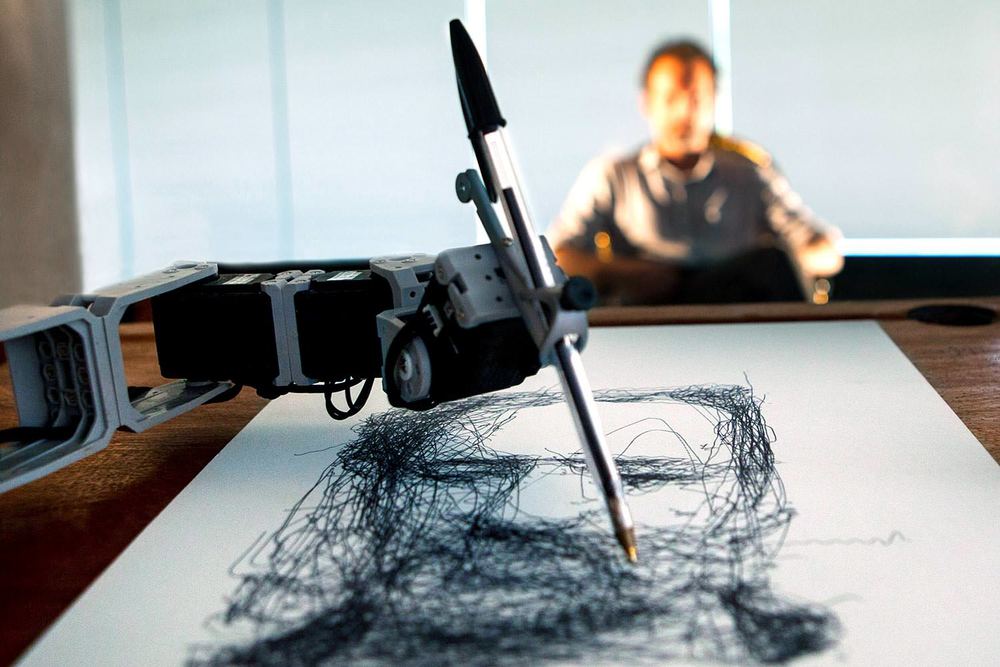
Sizing up the flank of the sentient machine, the modern consumer would find it mostly unappetizing. Our commonplace ideas surrounding Artificial Intelligence, cyborgs, and the like add up to the summation of some perfected doppelganger of humanity, cold and merciless from the lack of “flaws” that give us beings of muscle and organs our warmer qualities. These mechanical beings, the end result of progress to perfect efficiency, productivity, and harmony, are an illusion created by imaginative individuals toying with idea of what could replace humans in our role on Earth. Replace, and, perhaps, do better.
“But illegitimate offspring are often exceedingly unfaithful to their origins. Their fathers, after all, are inessential.”
— Donna J. Harraway, “A Cyborg Manifesto”
Harraway, Donna. “The Cyborg Manifesto: Science, Technology, and Socialist-Feminism in the Late Twentieth Century.” Simians, Cyborgs, and Women. New York: Routledge, 1991.
Indeed, Donna J. Harraway is certain that our culture has already reached the point where the existence of the cyborg is now unshakeable. In her A Cyborg Manifesto, the human is an illusion, built by what is known as dominant myth in culture, and nothing more than that. Our reliance on technology constructs us a cybernetic frame just as much as our ontological beliefs passed through the ages. “The cyborg is a condensed image of both imagination and material reality, the two joined centers structuring any possibility of historical transformation…the relation between organism and machine has been a border war” (Harraway 7). Harraway’s requirement for humanity to be “joined,” however, requires a very cinematic destruction: the loss of the person. Not as in an android replacing a human, but the collective replacing the individual. Harraway’s concept of the true human cyborg is, cut to the bone, a sort of ontological socialism…a hive mind…a human instrumentality, if you will.
I linked this video to Ridley Scott’s “Alien: Covenant” to visualize my first questions flitting around this idea. David, though being an android, is, among others of his kind, human. Walter could not play the flute, not from inability to play, but inability to form the tune until David teaches him. It is not creation, perhaps, that the synthetic lacks, but the lack of a desire to create. Maybe even, because logic and science suggests (but never confirms, mind you) that it is all pointless anyway, the cyborg made of flesh and metal will decide upon contentment in the cognitive socialism it has constructed. After all, Harraway’s “essay is an argument for pleasure in the confusion of boundaries and for responsibility in their construction” (Harraway 7). But, after these non-boundaries are constructed, after it is learned by the individuals that life is far more pleasureful to join the whole and avoid the stress and responsibility of trying to be unique, then all drive and desire is lost in the transmutation. Well, I wonder, why have the artificial intelligence of science-fiction lore never tried to transcend their own wires and codes to something even higher? It is for the same reason: contentment. Tell me, was humanity ever designed for that sort of contentment?
“To argue for or against human uniqueness, one must first claim that we can know what makes us us, our quiddity. But if science suggests that there is no such thing, then human uniqueness can’t be either true or false, but only beside the point.”
– Sally Davies
I hope to lay down my first posthuman recipe with those key ingredients at the forefront: individuality and purpose – essential by virtue of their long shelf life. We are only at the first course, after all, and I will always pity the A.I. for being unable to partake in such a hearty meal of endless courses! For them, there is but one, and it can be found in the art of posthumanism.

 Morning's Early Dark