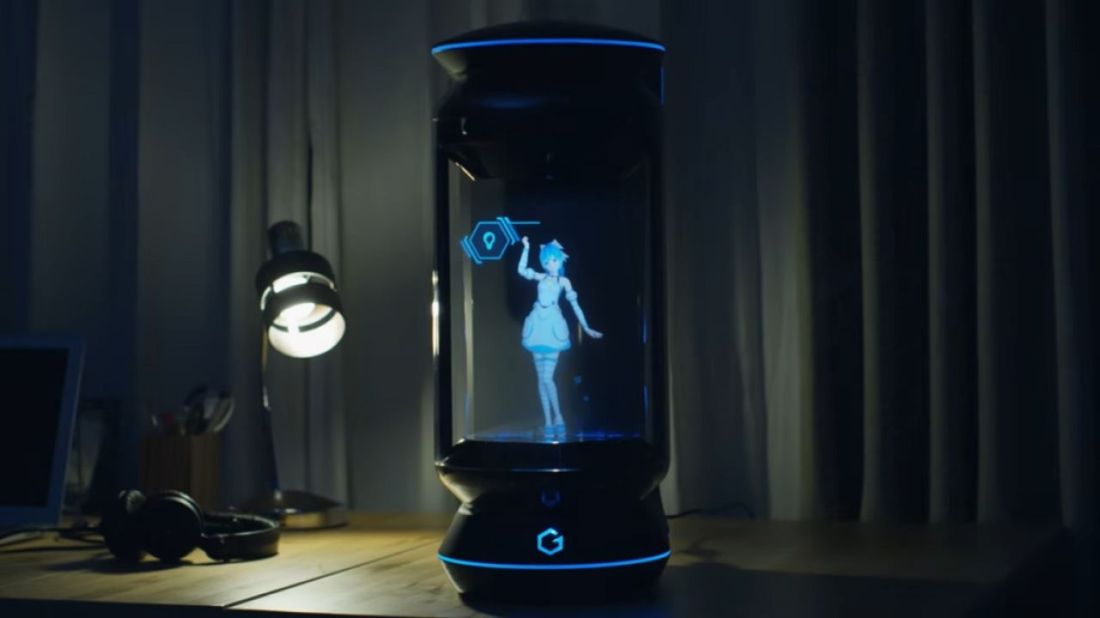
The dawn of A.I. companionship has been on the gradual rise for a very long time. So long, that I think it’s fair that nobody has figured out how to hit that “sweet spot” yet – the perfect balance of functionality and compatibility. How do we make it human, with none of the faults?
The funny thing is, the majority of people actually interested in A.I. companionship are not interested in this at all. Happy suburban families or ambitious up-and-comers without a cent to their name have no interest in the investment on A.I. companionship. They are quite satisfied with Alexas and Siris, who add a little bit of convenience to their daily lives but not much else. I personally use my Siri for little more than a lullaby machine playing distant train sounds, an alarm clock that can wake me to smooth jazz on iHeart Radio, and a bluetooth speaker. Thus ends my imagination with such a “companion” device.
But now we are on the cusp of true A.I. companionship, teased through the programs used to draft writing and art through the input of carefully coded keywords. The human trick in A.I. that makes it desirable is not its perfection, or its speed, even, but its adaptability. A computer, after all, will only put out what you put into it. But it will retain that knowledge, so that, the next time you ask for something, its response will take your previous action into account. A.I. does not work as “one-size-fits-all.” It must, as humans do, begin with a child’s scope, adapting to what it thinks will please us, the parent.
Consider the “Companion Robot” in the video above. Stilted and unexpressive, breaking silence and lack of interaction with the same cutesy hand wave motion several times in a row. It is not programmed to learn or adapt with its owner, but to fit a stereotype that many lonely individuals might find appealing. It is a harmless, unimpressive display (literally just a display, less of a computing mind) when compared to what could be. Like the RPG choose-your-route dating apps; all of it is scripted, a farce you act out under the false pretense that the program is reacting to you. A.I.’s new potential in 2024 has the possibility of mimicking human neuroplasticity, proving that perfection is built gradually, not shipped out at conception. That is not to say that this wouldn’t require several paid updates to achieve, however.
So, what’s stopping us? The biggest issue, besides the mires of cybersecurity and legal precedent, would be target audience. I know it came off that I was certain what people were looking for, but one of the most deceiving characteristics of a human’s relationship with their own neural pathways is what they truly want. Do they want what is easy, predictable, restrained? Or do they want what is complex, spontaneous, raw? That we still have such a hard time mapping these desires out in relationships with other people means that companies and the A.I. themselves will find themselves at odds with what they think the customer wants. Worse yet, there is the possibility that this contentment in fruitless endeavors and relationships with an A.I. companion will wear off, or perhaps not even take on. For the psychological stimuli of “happiness” is often accompanied with a lasting physical reward registered by the one of our five senses. No hologram can stimulate more than two senses, and the brain will never accept such a pseudo-existence as a complete companion.
We are fast approaching the 10-year anniversary of the beloved cult hit video game UNDERTALE. And while I still haven’t managed to defeat the final boss of the Genocide route (yeah, try THAT on a Mac), I am at least satisfied with having seen the narrative perfection in its entirety on Youtube, and gone through the Neutral and Pacifist routes on my own. A long, long time ago. Though appreciation for its minimalistic beauty lives on, that appreciation would be less impactful if not for its statements on Posthuman morality. Spoilers of course, for those who have never played the game.
Depending on whether or not you kill or talk your way out of battles with “enemies” in the game, and counting the ratio in which you choose one or the other, the program will judge you and determine whether or not you are deserving of a happy ending or are in need of Sans’ interference. This is, of course, after you have already completed the unavoidable neutral route on first playthrough. In Neutral and Pacifist routes, the main antagonist is Flowey – a miserable little shrub who is the resurrected spirit of prince Asriel Dreemur after he was slayed by humans. Besides Sans, Flowey is the only citizen of the Underground who is aware of multiple save states that allow the player to change the outcome of their future. Unlike Sans, however, Flowey goes one step beyond being aware. He is able to lock and manipulate those external save states himself, even so far as to trap us in an unalterable state right before his final boss battle in the Neutral path.
Most players prefer to focus on Chara as the main antagonist – the game’s interpretation of our own corruption as we kill characters we have become attached to, never letting us forget past many saves that the ones whose company we enjoy we have erased in previous saves. But this is not entirely fair, since many of us will return to the Pacifist route afterwards to leave things in a better state than they were, having only ventured down this dark path for completionist’s sake. What’s more, we are still conscious that this is but a game – the characters only exist on one side of the screen, in a scripted and programmed reality. Chara is the bad end – we can’t even fight her. She is the extreme moral warning that the game throws at us to make a “relevant” moral statement about our relationship to expendable pixels on a screen. The old “violence in video games makes one violent in real life” argument.
Flowey is much more poignant as an example of this posthuman relationship between man and media. He has only stretched out to torment us, insult us, and try to kill us, AFTER he has already done this hundreds of times in his own world. Flowey, in death, became the gamer on the other side of the world, playing his own game despite our interference while we are playing ours despite his. Flowey is the mirror image of the player, manipulating and abusing both his own reality (UNDERTALE) and the reality outside his own (our reality). But he is not just an end game finality, but an active and constantly destructive force; after all, the player cannot become Chara until after they confront Flowey in his absolute form. Then, they must choose to either take his place or bring him back to the light via emotional breakdown.
The secret to Flowey’s connection to the player is in his death – Asriel was killed by humans. Undertale, to prove allegorical points, uses killing and death as blanket extremes for much more precise ways of negatively affecting those around us. Asriel might have been killed, but it was the violent social rejection that turned him into the monster that is Flowey. “It’s kill or be killed” is his mantra, a moral line so blurred that it can easily change to “It’s lie or be lied to,” “It’s betray or be betrayed,” “It’s abuse or be abused,” “It’s manipulate or be manipulated,” and so on and so forth. Our empathy connects us to these characters’ stories, the words of real humans written in a way to speak to and affect other humans – that is why we feel bad when we kill them for the sake of playing the game. But such is the script – following it does not make us a monster.
But to delight in putting these characters through pain, in exerting power over those who cannot resist our control…can we see that played out in real life as well? Not in the act of murder, perhaps, but in how we view people as means to an end, as tools to be wielded and discarded at will, as NPCS in a video game where we are the main protagonist? This Solipsistic dilemma is where the Floweys of the world show their true thorns – and why not take objective morality off the table when you’re god of your own little world?
In the years of my youth I was acquainted with a boy who could not, or would not, speak. His facial expressions were the closest thing to a language, through which I understood him in flourishing gestures, though even then there were more than two ways to interpret a mere shrug or the slightest smirk. As my familiarity with him became more defined, this boy revealed to me that he possessed a particular passion for writing. I begged him, grant me some transcript to peruse, but was promptly refused. Everything he wrote must first go through his sister, whom he trusted as his editor and sole confidant, that what filled the page may be readable. I searched for his sister, hoping she might be better inclined to satiate my interest.
She was. The girl was less worried about betraying her brother’s confidence; rather she delighted in showing just how incompetent his skill. I read his rough draft thoroughly. It wasn’t bad, a few grammatical errors, wanting some intellectual polishing here and there, but she showed no mercy.
“See, look at that!” she would wail. “I always tell him, you’ve got to stay awake and listening, awake and operating deliberately on codes of better conduct!” I didn’t quite understand what she was saying, but the lamented passage was one I, too, found fault with, but only in a few places; she crossed out the entire block and began scribbling her own trail of thought. I protested, insisting it to no longer her brother’s work, but she ignored me.
“He has to learn to be both well-spoken and well-heard. If he doesn’t pay attention to whom his audience is, no one will read it. Worse, he’ll look insensitive for being so wrong.” I tried to explain that not everyone looked through the same lenses, that there would be people with his same frame of mind, and that she ought to listen to and negotiate with his side before writing the contrary behind his back. I also proposed her to consider writing her own material, but she stopped paying attention by this point, avoiding a response that I would have perceived as angry. This supposed intellectual was not interested in crossing boundaries through “voicing” her complaints, but ignored her brother’s voice to fill in her own when he was powerless to contest. I left her in her brooding irritation.
I found a few of my friend’s papers later on, after they were published. He was congratulated, but soon forgotten, as the steady stream of ideas similar to his sister’s remained unopposed. My guess is, writers of different experiences felt invalidated and remained silent. But that’s no excuse. My friend did not choose to be unable to speak, not at all; but it is no one’s fault but his own that he has remained without a voice.
Anime is a big inspiration to me. In fact, it is the bottom line, the de-facto inspiration from which most of my stories and characters and even philosophical ideas have been roused from. Whatever stories I write, though I credit them as being from God, they were kick-started by my watching anime, almost every single time across over three-hundred shows and movies. So trust me when I say, even in the most commercial of anime, there is usually a lot to unpack, specifically because the human connection is always at the root and in the leaves of the issue, in the skin and in the heart. That means posthumanism gets to nestle there in the trunk, right in the meat of the muscle, between the two layers of humanist interaction.
Sword Art Onlineis one such show. One about gamers trapped in a virtual world, trying their best to go on living despite the fact that this is both their new lives and yet not living at all. It will be tricky to explain, but it can be done.
Sword Art Online, also known as SAO, is a super-hyped virtual reality game in the anime of the same name. We begin with the game’s worldwide launch, where 10,000 people log in to the server through a helmet-like piece of equipment called the “Nervegear.” The game is a fantasy RPG, where you battle and fight in an almost “realistic” world. In fact, it’s more like living in a different world than playing a game (this show was the one that started the huge boom in a genre known as “Isekai.” Keep that term in the back of your mind for later). The day of the launch, Kirito, our protagonist, discovers that he is not able to log out. But he’s not the only one; every single player across the server is stuck in the game, unable to disconnect the Nervegear. It turns out that the creator of the game, Kayaba Akihiko, designed both SAO and the Nervegear to be inescapable; if you die in the game or are forcibly disconnected from outside, the Nervegear will fry your brain, killing you. So, it turns out that the program of SAO, a 100-level world called “Aincrad,” will become the new true reality of Kirito and the 10,000 hostage gamers.
Or will it?
Yes and no, actually. In the first month, still trapped on the first level, 2,000 players lose their lives. Even Kirito, a beta-tester who is heads and tails above the rest because he retained experience from playing the game early, is unable to make any progress. But one can still level up on the first floor, raising HP and defense to levels that would make one still more resilient than any normal human in the same situation. So how on Earth did a fifth of SAO players lose their lives on the very first level, within the span of one month? A possible answer to this nasty question is given in Episode 3.
In Episode 3, Kirito joins up with a small guild to go on regular dungeon raids. He seems to develop a bond with them, and feels a desire to protect the group. He is an asset, but tries to not be too conspicuous as a beta-tester around them, as beta-testers are considered cheaters and generally disliked. He manages in this pseudo-paradise for a while, since this might be the first time in a long time that the game actually feels like a game, but nothing good that is false lasts very long. Venturing into a trickier dungeon, Kirito and his guild fall into a trap with mass-spawning, high-level monsters. Kirito fights as well as he can, letting loose, but he is unable to protect the rest of his team; only he and the leader, Keita, survive. Keita blames the deaths of their friends on Kirito, and throws himself off the edge of Aincrad to his death.
Out of the 2,000 who died in the first month, how many of those deaths were suicides? This number is never really given to us, perhaps because Sword Art Online is an anime not really concerned with anything other than entertainment (it’s latest seasons have been criticized for that sort of wish-fulfillment shallowness). But I am genuinely curious, if people found they were trapped in a virtual world where death in the game means death in real life, how many would find that sort of existence futile?
The majority of Sword Art Online’s early episodes are about life in the game, and how the players plan to work their way to level 100 and escape the game. Many seem to adapt, with some choosing the paths of the warriors to level up, some choosing to be merchants, some helping to raise the children trapped in the game, and so on and so forth. Besides the fantasy elements, life in the game is being lived as normally as possible, and not like a game at all. But then, is that really life?
Heidegger might be in agreement with this sort of acceptance and harmony. He states that “we shall never experience our relationship to the essence of technology so long as we merely conceive and push forward the technological, put up with it, or evade it” (Heidegger 4). However, in this improbable scenario he might not have foreseen as even an avenue of fiction, Heidegger seems to be at odds with himself. “One says: Technology is a means to an end. The other says: Technology is a human activity. The two definitions of technology being together. For to posit ends and procure and utilize the means to them is a human activity” (Heidegger 4). Trapped in a game apart from your life outside of it, is there an end? When even the first level seemed impossible for everyone, was there even an apparent means? Rather than extend the human being or provide purpose, the Nervegear strove real purpose away; any attempts to move with purpose in the game world was to simply restore what had been taken. And, by that point, what had been taken (relationships, jobs, schooling, etc.) might even be beyond repair with the players’ absences.
or the first few episodes, Kirito has no purpose. He’s not sure he wants to get stronger, already being one of the strongest players in the game, and he basically wanders around doing favors. When he finds Asuna, a player whose strength was close to his despite not being a beta-tester, he finds a new purpose in his love for her. They even get married after a year since they were held hostage by Kayaba. When he escapes the game at the end of the first arc, but she is still trapped inside, Kirito’s life never picks up; his whole purpose is still wrapped up in her. But when he frees her, it takes them a while to recapture their love from within the game, and years for Kirito to finally propose again. What happened? Was that reality full of different value than the real world, despite the same function and connections?
Yes, the value was different in that there was no value. In the Posthuman world of Aincrad, the loss of value was required for players to find the will to keep living. Because what they achieved in the game did nothing to further their real lives outside the game, but only extend their survival within the game, value must be re-situated from tangible product, from something that lasts and extends well-being, to simple experience. Many of those two-thousand people who died in the first month, I am certain killed themselves when they saw that existing past the heartbreak or the loss of lasting purpose was a futile act that didn’t even count as an act.
To survive this would require an ignorance of Heidegger’s first supposition, and a denial of the second, though he meant these two suppositions to work together. But when the reality supported by technology is a false one, in that the whole existence is supported by the desire to escape that existence, then is living in the game living at all? What it certainly isn’t is suggesting that the “technology is means to an end” (Heidegger 4). “A means is that whereby something is effected and thus attained” (Heidegger 6). But in a forced and extended virtual reality, set apart from real life, nothing can be attained or effected because the two worlds are isolated from each other. The technology is self-sustaining, and erasing any possibility of an end beyond the Nervegear’s virtual reality. Technology and man are isolated, and man consequently, stuck within cyclical technological pattern and code, loses meaning.
Therefore, to survive without reaching the point of Nihilism, the survivors must focus on the idea that “human activity” is all that matters. Considering Kirito’s marriage meant little outside of Aincrad, and that the non-existence of Asuna’s conscience in his real world was devastating, it is probable that Kirito’s whole rationale of existence had changed to focus only on that activity of simply being. He’s not a hero, he’s not a husband, and now he seems to have no future because of all the time he’s lost; there is definitely a culture shock in that transition between a virtual and a tangible world. Keita, in committing suicide, was making a statement that nothing they did towards finding a place in the virtual world mattered, because none of it lasted and that experience did not matter if it did not further their grasps for security.
So, would we commit suicide if we were hopelessly trapped in a virtual reality? Is living an existence that does not rationalize or push itself towards a lasting end make sense? How is it different from all the time we spend in those virtual realities that we are able to pull ourselves out of? I do not quite know any of these questions, because something as integrated as the Nervegear is still far, far away from being developed. Unfortunately, as another caveat to critically analyzing Popular Culture, Sword Art Online is primarily a commercial show; it’s not really concerned with asking deep questions like these.
But we are still grateful that its illusions are at least substantive enough to make us question our reality. That’s not enough to give purpose, but it’s enough to give direction.
Works Cited: Heidegger, Martin. “The Question Concerning Technology.” The Question Concerning Technology and Other Essays. Trans. William Lovitt. New York: Garland Publishing Inc, 1977. 3-35
I know, I know, I’ve dealt mostly with animated television shows up to this point. But there’s just something about that mode of storytelling, both entirely human and not at all, that presents a way of looking at reality both obscurely and totally clearly. Every story has a chance of being a parable, because audiences don’t recognize the connection they share with the themes when they are too focused on the characters and the spectacle of the whole thing.
Hideki Anno’s Neon Genesis Evangelion is one of those shows that manages to breach that soundproof wall, by virtue of audiences either rejecting it as a “good show” in absolute confusion and emotional destruction or calling it one of the greatest in all anime from absolute confusion and emotional destruction. Yeah, the factors are pretty much the same, because it all comes tumbling down based on how you react individually, apart from the reality you use to connect to a show normally.
Neon Genesis Evangelion aired in Japan from 1995 to 1996. It was a mecha show about a young cowardly boy forced to fight aliens, known as “Angels,” in a giant robot created by his neglectful father. Shinji Ikari, in an attempt to impress his father, Gendo, and save the life of his cute injured pilot predecessor, Rei, hops in the robot and fights an Angel. He wins, is made a pilot of the “Evangelion,” and joins the war against the Angels as they threaten the end of humanity, known as the “Third Impact.”
Thus begins Shinji’s downward spiral into traumatic self-destruction.
What Neon Genesis Evangelion truly deals with is the complexity and pain of human connection. Understanding people and getting them to like you is sometimes impossible, and always immensely frustrating. The series doesn’t start off like this, focusing more on the flashy kaiju battles and Shinji’s self-doubt. Whatever character development we witness is isolated, especially as Shinji is obsessed with Rei despite the fact that Rei is a mysterious and silent figure who doesn’t really indulge Shinji’s attempts at friendship. As Shinji is consistently hurt or overburdened by those around him, he withdraws into his head, becoming almost as distant as Rei is. Honestly, the show becomes rather difficult to watch around those first episodes as we watch anxiety slowly turn into depression and desensitization.
But then, something happens. Both our world and Shinji’s turn upside-down AGAIN in episode 8. That episode introduces a new pilot, Asuka, who turns the entire show on its head. She is abrasive, selfish, loud, rude, extremely talented, and loves what she does; a complete foil to Shinji in every way. The tone she brings is also a complete foil to the tone we were used to, as scenes become livelier and the mech genre actually gives way to slice-of-life comedy for most of the episodes. There’s even an episode in which Asuka and Shinji must completely sync their movements if they are to destroy the core of an Angel that can split and replicate itself…Naturally, they learn how to do this through the power of dance.
Almost like the character of Shinji himself, the addition of Asuka allowed the show to reroute its almost prehumanist notions, in which the human is isolated by and for his own means, into humanist territory. Sure, Asuka is a little brat most of the time, but this conflict, based in the fact that they butt heads as competitors and not as those whose judgments determine their value as human beings, is exactly what is needed to pull Shinji out of his shell. Or, rather, to help the little hedgehog unfurl.
By hedgehog, I refer to the name of episode 4, “Hedgehog’s Dilemma.” The hedgehog’s dilemma is this: in winter when hedgehog’s must snuggle together for warmth or else freeze, they end up impaling each other on their prickles. This has direct connotations for human connection; human beings must interact and connect with others if they are to keep their sanity, but sometimes the pain that occurs as a result is too destructive. Shinji was overburdened by this dilemma in the first seven episodes, and by his responsibility as a pilot that made him virtually no more than what Rei was: a tool to save the world. With Asuka, he goes through the constant prick of her needles, but it gives him life because someone acknowledges him as a human being and individual. It is a move from prehumanist to humanist, in eight episodes, that lasts until about episode 17.
But something happens at episode 18. Somewhere along the way, as the intentions of Nerv (the organization behind the creation of the Evangelions) and Seele (the organization behind Nerv’s funding) are slowly brought to light, we see another transition. This time, oddly enough, it is regressive, as traumatic experiences and the realization that they are just tools for Nerv start to eat away at Asuka and Shinji. Soon they are no help to each other, because they are so far gone to depression that human connection isn’t even worth the effort. Asuka, in one last attempt to prove herself as an individual, is completely mentally wrecked and tries to commit suicide. She is discharged, and Shinji is all alone again with Rei.
Then this bastard shows up.
This fellow is Kaworu, the replacement for Asuka in episode 24. Kowaru becomes friends with Shinji, understanding him like no one else, and appreciating him as an individual. It is a short-lived bright spot in the otherwise darkened life. I called him a bastard (rather impolitely, I admit) because he technically is one; a mixture between Angel and human. He was literally created by Seele to be a tool, the one who brings about the Third Impact. However, he realizes that his version of Posthumanism, unconditional empathy, is in direct conflict with Seele’s version of Posthumanism. Seele created the Angels, in truth, because they would bring about the Third Impact and merge all of humanity into one giant pool of melded consciousness. That collective consciousness is both death and rebirth, into both everything and nothingness. de Spinoza almost reflects on such idea when he considers the circle, the complete linked existence of the minds of God and Nature, and how humanity might find the prolonging of life and satisfaction from this:
“For example, a circle existing in Nature and the idea of the existing circle, which is also in God, are one and the same thing, which is explained through different attributes. Therefore, whether we conceive Nature under the attribute of extension, or under the attribute of thought, or under any other attribute, we shall find one and the same order, or one and the same connection of causes, that is, that the same things follow one another.
When I said [NS: before] that God is the cause of the idea, say of a circle, only insofar as he is a thinking thing, and [the cause] of the circle, only insofar as he is an extended thing, this was for no other reason than because the formal being of the idea of the circle can be perceived only through another mode of thinking, as its proximate cause, and that mode again through another, and so on, to infinity. Hence, so long as things are considered as modes of thinking, we must explain the order of the whole of Nature, or the connection of causes, through the attribute of thought alone. And insofar as they are considered as modes of extension, the order of the whole of Nature must be explained through the attribute of extension alone. I understand the same concerning the other attributes.
So of things as they are in themselves, God is really the cause insofar as he consists of infinite attributes. For the present, I cannot explain these matters more clearly” (119-120).
de Spinoza, Benedict. A Spinoza Reader: The Ethics and Other Works. Ed. and Trans. by Edwin Curley. Princeton, NJ: Princeton University Press, 1994.
That is the Human Instrumentality Project. To bring everything into the same circle is to bring order, peace, and complete understanding. By achieving infinite being, there is no desire, striving, or even hope for completion, and therefore no disappointment. We have gone from prehumanism, to humanism, to prehumanism again, and now this. This is the extreme principle of Posthumanism; all are one, individuals are meaningless, and we are desensitized to the disappointments of life. Yes, there is a middle Posthuman ground, but it is unstable among those of differing values and ideals. By making all consciousness one, everyone is of the same mind; everyone agrees, because it is impossible to disagree. As an Evangelion pilot, to prevent the destruction of humanity, and even at the urging of Kowaru, Shinji kills Kowaru. And then, after apparently halting the Third Impact, he discovers that no one cares what he did. Or, specifically, no one cares about him.
And then the show ran out of budget for the final two episodes. The Human Instrumentality Project actually begins, with no reason as to how that happened, and we are given a peek into the joined minds of all of our characters as they realize that the merger is actually more isolating than being human; they are now trapped inside their own consciousnesses. But the studio received backfire for the execution, the scenes were quickly and cheaply slapped together, and so none of it made sense. Then Anno received death threats, the studio feared for its further existence in the trust of the public, and a budget was created for a movie finale.
And boy. Was it a finale. It was fun in the first three-quarters, when Asuka returns, Shinji grows the nerve to fight again, and character arcs are paid off. But after all that buildup, all that character development, all those psychological studies, we are given a final Nihilistic bow as the Posthuman extreme of the Human Instrumentality Project ends both the film and the whole planet.
Even if you watch the whole show, it still barely makes sense.
And yet it makes total sense. The whole reason behind Seele’s obsession with the Human Instrumentality Project was because human contact was unfulfilling, painful, and finite. The loss that propelled them towards an extreme Posthumanism was loss of identity, because identity separates and creates pain. The struggles of understanding and connecting with those whom we want to connect to are, to proponents of this “Nirvana” mentality, foolishly skewering ourselves on the prickly backs of each other. As one mind, we know all, we are all, we feel all, and so we encounter nothing so much as we are the encounter.
And yet how do we transition between humanism and the step before this, the middle-ground posthumanism? The truth is that we already have; by regulating people based on identity, not individuality, and diminishing the value of human connection through mass social connection (see my “Gotta Call ‘Em All” post for discussion on this subject), we are closer than ever to Human Instrumentality. Now, biblical references aside, is this merger actually possible at all without some supernatural occurrence? Only the limits of technology can say for sure.
And for those who choose to resist, to hold on to the humanist, to refuse to lose their individuality? The end of the series’ film, End of Evangelion, suggests that individual survival is still possible. But it’s not satisfying. It’s not comforting. It’s too loud, too vast, too complicated. And the film ends with a line that can only be the proper assessment of those two terrible ultimatums of being human:
“How disgusting.”
You can check out Neon Genesis Evangelion and End of Evangelion on Netflix.
Why don’t we start the list of Posthuman texts outside of my comfort zone? Usually, I prefer to philosophize on universal themes or ideas that I can at least talk extensively on, if not personally relate to. Hence, “comfort zone.” But that sort of thinking puts up limits and boundaries in human intellectual connection, keeping my realm of expertise cradled in a tightly-wound basket. It limits my audience, in other words, and that’s no good as a creator. Since we’re about rewriting posthumanism through loss here, I’m going to lose my inhibitions; we’re going to talk about sexuality in a children’s show.
Yeah. I didn’t say this would be within your comfort zone, either.
Miraculous: Tales of Ladybug and Cat Noir is a CGI animated superhero show produced by three different studios from three different countries: Zagtoon in France, Toei Animation in Japan, and SAMG Animation in Korea. It’s the story, as these superhero wish-fulfillment shows tend to be, about a teenager with magical superpowers who fights evildoers while also keeping her identity secret. Basic stuff, not too nuanced. What you wouldn’t know from that synopsis, though, is that the main draw of the show is not in the superhero-ing, or the villains, or the lore of the magical mystery items that provide the main character with powers. All of that is as inherently interesting as our superhero-obsessed culture can find it, but the main draw of the show lies in the second genre Miraculous falls under: romantic comedy.
The protagonist, possessor of the Miraculous that enables her to become Paris’ lucky-charm superhero, is Marinette Dupain-Cheng. Marinette is your average girl, except she is above-average when being clumsy and awkward around her idyllic crush, Adrien Agreste. Little does she know that Adrien is actually the secret identity of her partner in fighting crime, another Miraculous-wielder who goes by the name “Cat Noir.” When they fight together, the roles are reversed; he is flirtatiously in love with Ladybug, while she playfully blows him off at every turn. It’s a purely innocent and sweet relationship for kids to watch, except when parents read a little too much into Marinette’s obsession.
But why is my complicated plot synopsis essential for understanding sexuality in Miraculous? This ironic love rhombus, paired with the fact that the “villain of the week” is always someone turned evil against their will after they have had their feelings hurt or dreams crushed, helps the romantic-comedy genre rise above the superhero genre. Though sporting some of the best 3D choreographed scenes I’ve ever seen on TV, the fights and villain plots are outdone by the relationship plots. In other words, this is a humanist show, one about love, friends, and human connections in general. There isn’t really anything Posthuman about Miraculous, as it’s primarily a children’s show and meant to entertain above all else.
But then the 2nd season came around, and the writers upped their game to appease their growing teenage and young-adult audience. This meant less episodic storylines, focusing on progress in Marinette and Adrien’s (and likewise Ladybug and Cat Noir’s) relationship, even crossing between the two so that Ladybug could have development with Adrien and Cat Noir could spend time with Marinette. But complex storytelling also calls for complex themes; iven France’s cultural tilt and the older audience’s fads, we are treated to a few moments of progressive push.
Normally, that would annoy me. But not here. Miraculous does it right.
Meet Marc. Marc is a character who didn’t exist until Season 2, Episode 21. I thought Marc was a girl at first glance; his face and voice are rather feminine. He has a far brighter shade of coloring in his lips compared to all the other character models in the show, even among some of the girls. He wears a boy’s hoodie but a girl’s t-shirt. He wears a choker and fingerless gloves, painting his nails black. And, if that’s not enough, his last name, Anciel, is actually wordplay on the French word for rainbow: “Arc en ciel.” He is, on the surface and down to his very core, a plug for the LGBT community. In a kid’s show. Not such a rare or confrontational concept anymore, if I’m being honest.
Nevertheless, I would have issues with depictions of sexuality in any show directed at children, period. The main protagonists get away with it, as they so often do, because eight-year-olds do not associate a crush with sexual feelings until much later in life, but associate male and female pairings directly with the very understanding of love (though social media is chipping away with a jackahammer at this innocence). Heck, I still don’t associate the two together; there’s a difference between pining for sex and pining for affection. But the creators of Miraculous seem to have the same feeling, as Marc’s sexuality is never even brought up. Until I did research and discovered that the show’s primary writer, Thomas Astruc, apparently said in a comic-con interview that there would be more diverse characters, including those of sexual persuasions, I actually couldn’t tell if that’s what Marc here was supposed to represent.
But his story makes it pretty obvious.
Marc is our villain of the week. By virtue of the shows formula, we know this right from the get-go. It all happens because of a misunderstanding: Marc is too shy to approach a classmate he respects very very much, Nathaniel, and angers Nathaniel through his poor attempts at connecting with him to so some intimate work. Nathaniel then erupts at Marc for the wrong reasons, and Marc, heart broken, is “akumatized” by the show’s chief villain, Hawk Moth.
That’s the plot. Sounds very “homosexual kid gets ridiculed for coming out of the closet,” doesn’t it? But sexuality has nothing to do with it. Nor does finding one’s identity, struggling with romantic feelings, or even a single display of affection beyond respect and friendship. Marc’s chief goal, you see, is to work as a writer with Nathaniel, a proficient comic book artist, on a comic tribute to Ladybug. Nathaniel, misinterpreting Marc’s sheepish and roundabout advances as ridicule directed at his love for Ladybug (and the fact that he had already been akumatized in an earlier episode), blows up in Marc’s face. Therefore, sexuality is not a problem, because it is never addressed as being important to Marc or even in his character’s head.
And yet, somehow, we are aware that he is representative of the closet homosexual. His struggle is one we’ve seen time and time again, with more direct reference, in other mediums. Even his Akumatized form, Reverser, is almost synonymous with conversion therapy, in which he can reverse the natural state of anyone he hits with his origami airplanes. Miraculous approaches core issues with a symbolic lens, meaning that the life lessons are encouraged without actually touching upon the subject. But, me-oh-my, how can subtlety be expected to help the LGBT community in Popular Culture? That answer can be analyzed through a little competition between ontology and epistemology, and their representations on the screen.
Take a look at these photos from a Disney Channel Show, Star vs. the Forces of Evil, in its episode “Love Sentence”:
Yes, we’ve got what are considered our first homosexual smooches in a children’s animated cartoon. It’s in the background, so it’s not very prominent, but the show received both heat and praise for what it did, the brave steps it took.
I respectfully do not agree.
There is a difference between Miraculous and Star vs. the Forces of Evil. That difference is in their presentation of love. For Marinette and Adrien, neither really know how to process the feeling, or even understand it is the right feeling at all. Love is depicted as a bond, a connection, that two people share when they feel like being more than friends, but in a different way than best friends. It’s almost closer to admiration, actually, or idolization.
Star vs. the Forces of Evil stars Star and Marco, who also have to deal with feelings they don’t understand. However, it is much more complex and prominent here, and a kiss, while a big thing, is not a rare thing, and not always with the necessary scenario set-up of loving interaction. In other words, the kiss becomes a social construct that is the result of animalistic impulse, and disassociated with the feeling or mindset of love. Or, at least, with what a child’s conception of the feeling/mindset of love is.
Perhaps I read too far into this show. But where Star vs. the Forces of Evil takes a less avoidable misstep in presentation (though the fact that the theme of the boy band in the episode is prison related, which is a rather embarrassing coincidence), there is another show that is even worse.
Nickelodeon’s Loud House is that show:
Loud House features a gay, bi-racial couple; two diverse birds with one progressive stone, basically. The interaction between the married characters at first glance doesn’t seem to be problematic. But, as we were saying earlier, the war is between epistemology and ontology; the study of knowing (represented by humanism) and the study of being (represented by posthumanism). It is the little animated touches, the vocal inflections, the fact that the main character opens the door with the line “Time to make history!” is the big indicator to children that these two characters are in the same position as your mother and father. And what do children think at seeing that?
Or, considering “Maturana’s work on reflexivity in sensory processing and Varela’s on the dynamics of autonomous biological systems” and how “the two authors expanded the reflexive turm into a fully articulated epistemology that sees the world as a set of informationally closed systems” where “Organisms respond to their environment in ways determined by their internal self-organization” and “their one and only goal is continually to produce and reproduce the organization that defines them as systems,” how do you think they’ll react (Hayles 10)?
“That’s weird.”
Yes, most likely, children are going to find it weird, and almost averse. You thought I was going to get on to the shows for depicting homosexuality? That is a problem, as I have stated, but the bottom line is that this hurts the LGBT community above all others. What you have is children being told to know something: that two same-sex spouses or same-sex kisses are normal. But, chances are, those are not normal to children. And this will not make it normal to them, by any stretch, because their immediate reality does not depict it as such. So, what to do? Instruct kids in school just how normal it is? No, because then you isolate the parents, who fire back for control of their children’s minds. The humanistic epistemological approach is a failure.
And so one must lose sexuality from the whole depiction of the LGBT individual. The Popular Culture ought to focus on their ontology, their state of being apart from their sexuality, and how that transfers into media. The reason Marc works is because we do not explicitly know his sexuality; children, therefore, look at him as a character operating on his own agency. Yes, there are stereotypes, as I listed at the beginning, but stereotypes exist because they are true in some form or fashion. By focusing on the simple state of being of the character (all that really young children can process, anyway), not knowing everything about them, they become part of the show’s world, and consequently the child’s reality.
Marc’s example is an example of how the ontological approach, and the loss of knowledge, is a posthuman step forward for the LGBT community in media depictions. Sure, it waters down identity, but children aren’t at that point yet of caring beyond their immediate experience. Instead, if they see someone who acts like Marc, shows similarities in some form or fashion, no prior knowledge is questioned. They accept them as part of their reality, just as Marc is accepted as part of Miraculous’ reality.
In other words, as far as the nature of being homosexual is concerned outside of the sexuality itself, the characteristics of those prescribing to it are now normalized. And, you know, sometimes small steps like these are all you can ask of kids if you want something done right. Especially when the adults are looking over their shoulders.
You can check out Miraculous: Tales of Ladybug and Cat Noir on Netflix.
Works Cited: Hayles, N. Katherine. “Prologue” and “Toward Embodied Virtuality.” How We Became Posthuman: Virtual Bodies in Cybernetics, Literature, and Informatics. Chicago, IL: University of Chicago, 1999. xi-24
The first thing you think about when you hear the term “rhetoric” is politics. Heck, that’s still my own brain’s default, so I don’t blame you at all. We chalk up rhetoric as something we should be suspicious of, criticize to extremes because it is, by character, duplicitous, aimed at persuading us to buy something above all else. And that’s not far off from the truth.
But political rhetoric is but one part of true-blue rhetoric. So are those delightful rhetorical devices you are forced to use in research papers. And so is the rhetoric you use in normal conversation, creating or subverting subtext, sometimes even without your conscious knowing of it. Yes, taboo as you might consider rhetoric, you cannot avoid it by turning off your T.V. or taking those oh-so-brief hiatuses from social media. Rhetoric, you see, is the art of human communication, and how that communication perceives or crafts reality. The only way to completely escape it is to completely isolate yourself, a nigh impossible dream in a technological world where all things will be connected, if they aren’t already.
Enter Posthuman Rhetoric, a study within rhetorical discipline, birthed from our technologically-dependent culture. Posthuman Rhetoric contains the meanings and implications of a new über-interconnected world. It supposes how and in what situations our minds become as one entity, and the effects of technology and mass mutually-shared knowledge on the ways we communicate and interpret reality. It is the next step in a movement past humanism, which dictates that reality is made by, around, for, and from humans alone. Posthumanism is past humanism in sequence, but it is still connected to it in form. Still, the humanist must experience loss to achieve that transition into posthumanism, as it is meant to revise the reality that humanism once dominated. The loss can be either negative or positive, but it is a loss nonetheless.
Sounds totally bothersome if you’re a human, right? It is, unless you realize that you unwittingly engage with Posthuman Rhetoric every day through the medium known as “Popular Culture.” Oh, yes — that. That thing most people know through the phrase “pop culture references,” but don’t realize can encapsulate any medium of entertainment that has a standing somewhere in the modern world as part of its communicative reality. Movies, TV, video games, books, music, even famous personalities, are all a part of Popular Culture. Without even realizing it, by the virtue of being hyperconnected, most human beings engaged with Popular Culture have already begun their transitions into posthuman reality — though few ever really realize it.
And yet some of the pieces of Popular Culture directly reflect the losses required or occurring on the part of the humanist through its media. I’m here to assess those losses, calculate them, and see exactly how they reflect the humanist audience’s transition into a Posthuman reality. If you see a post titled *V* with a number (ex. *V3*), that marks the particular post as one of these vignettes.
Also, as a warning, THERE WILL BE MAJOR SPOILERS FOR MANY DIFFERENT PRODUCTS OF POPULAR CULTURE. I reiterate: you have been warned.
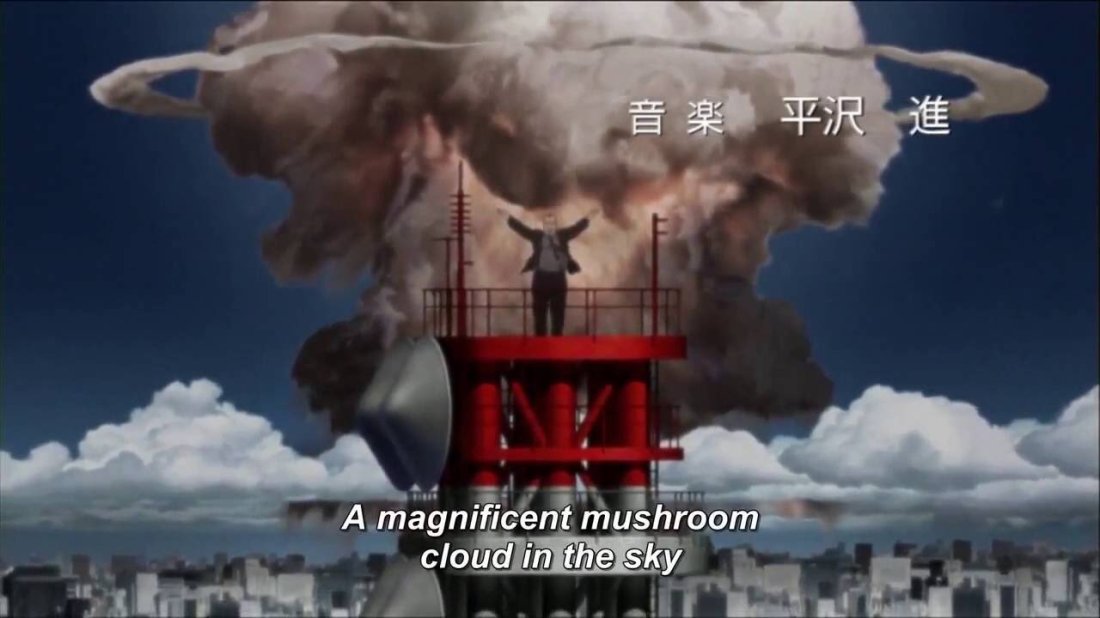
If you haven’t noticed, I’m rather obsessed with the concept of escapism. It is the primary reason why nothing gets done, mostly because we don’t always know when we’re indulging it. I think I first understood it as an object of study back in 11th grade, when I happened upon an anime, Satoshi Kon’s Paranoia Agent.
The show follows a multitude of characters in Tokyo who are experiencing difficulties or tragedies in their lives, and are consequently beaten over the head with a baseball bat by a mysterious roller-blading assailant know as “Lil’ Slugger.” The attacks begin with a character designer named Tsukiko Sagi, who has been struggling with fear and stress under the release of her anticipated new show. However, after the attack, her life and her attitude somehow become immediately improved. After the story circulates, people everywhere fall victim, and simultaneously beneficiary, to similar circumstances. Lil’ Slugger becomes a real entity, feeding off the public’s fear of reality and the truth, and Sagi realizes that all good false things come full circle by the end.
It’s a wonderfully weird show. But what fascinated me most was how popularized escapism was in the show, something that is usually an underscored psychological thirst that instinctual action tends to quench. And then, by doing so to relieve stress or entertain ourselves, we ensure that nothing gets done and complain that we never have enough time to do anything. This sort of thinking is inherent in all of us at some point in time. In fact, you might call it mankind’s natural disability.
“What we think of as “normal” human visuality does not see—and it does not see that it does not see…But we could also be more down to earth and simply note that this “not seeing” is crucial to the human being’s (and to any being’s) organization of an overwhelming flood of visual input into a field of meaning” (131).
Wolfe, Cary. “Animal Studies, Disability Studies, and Who Comes after the Subject.” What is posthumanism? Minneapolis, MN: University of Minn. Press, 2010. 127-14
While Cary Wolfe speaks primarily of an insensitivity to violence when done to organisms outside the human species, as well as the brain’s selectivity and filtration of the reality it perceives, can this not also extend to mankind’s reliance on escapism to blind himself to the reality that prompts the so-called “escape?” We do not have to lose the idea of violence here; anxiety can be considered a violation of emotional or psychological stability, and avenues of escapism are the way by which attention is averted from said violations. It is a stretch, but, with safe spaces and harmless reasons for offense and fear, there is no doubt that the stability of the healthy, happy, purposeful individual has been mauled in some way.
When I speak of escapism, I refer to any exercise of enjoyment or fulfillment that lays outside the immediate realm of the human themself. It usually involves the rudimentary entry-points of the posthuman: T.V., social media, tribal group affiliations, video game guilds and discords, etc. Essentially, a fantasy that absorbs the human’s self-consciousness, with no connection to their reality besides intangible gains or repercussions. One of the definitions of insanity is, according to the twelve-step program of Narcotics Anonymous, repeating the same mistakes and expecting different results. If you continuously waste your time on fantasies that don’t make your life any better, only distract you for a few hours, will your life ever get any better?
And yet, then the question of the “violated” mankind’s disability finds itself in a dilemma: is the handicap expressed in one’s inability to recognize and control the indulgence of escapism (addiction), or in one’s vulnerability to outside forces that drives them to consume escapist fantasies en masse?
“One of the major features of racism, sexism, and anti-Semitism has always been to assign inferior status to someone in order to exclude him (or her) from the human, to stigmatize him by virtue of physical traits that would place him within the world of animality” (69).
Derrida, Jacques. “Violence Against Animals.”
Again, taking a quote out of context in which Derrida is speaking of man and animal and their rights, I find it perfectly applicable to continue my thoughts and synthesize it with my previous blog post. What causes stress in humans? The external factors forced upon them by other humans. Therefore, in their escapism, the individual is trying to flee the world of a reality where anything human other than the ideal does not exist. This mindset, where humans are not to be engaged as human but as extensions of the individual’s reality to be bent, joined, or filtered according to their need to alleviate stress and fear. Humans are then considered even lower then animals to each other, more like drawings in a sketchbook that occasionally need a limb or two erased.
The worst part is that they escape from even this reality, too. Their brain filters it, filling it with disconnected ideas of universal love and balance/oneness with the rest of the planet. They feel whole, but they don’t feel whole, and in this constant search for feeling whole they don’t realize that the new terms on which they’ve founded human interaction is now a fantasy itself. It has become a consistent illusion, a never-ending interactive form of escapism that never breaks because everyone holds it together for the sake of their fear that the real thing is too much to handle.
Why did this happen? How, when, from whom? I have no definite answer, as even I am partially crippled from this insanity; no one is spared completely. Whatever the case, the rhyme or the reason, there is no doubt that escapism has become humanity’s all-encompassing, mostly-ignored debilitation. But that’s what happens when every single individual is their own Lil’ Slugger, whacking themselves upside the head so many times that fantasy becomes reality, and the truth like a dream.
This is the second post about my “Rewriting Humanism” project, functioning as my Annotated Bibliography. Sorry for those hoping for a new post, but I hope it’s some good news that I will be starting a different kind of blog, more of a deep-subject-study-wall, this time on Weebly.
My main focus in such a post is to show what subjects of popular culture I will be analyzing, as well as a few articles that I will apply to said subjects (as much as I would love to utilize my own postulating alone). In addition to incorporating Professor Read-Davidson’s suggestion that I limit myself to “well-known and influential examples within each sort of subcategory” (film, comics, non-fiction, etc.), I also propose a general overarching topic: loss. Whether on purpose or accident, through emotional loss, transformation, or escapism, I would like to study how popular-culture rewrites humanism through taking something away in our lives, and then replacing it with something else. Whether either “something” is defined or not, I know not; but hopefully we are at least aimed in a direction that promises a fulfilling journey, if not answers.
Below is a list of certain subjects and the articles I will connect them to, as well as the topic or scene I shall be studying for synthesis. Most likely, I shall find my sources as I continue researching on each individual piece (which is the process occurring as I am writing them all as we speak), but here is what I have so far:
Toby Fox’s Undertale, a meta video game. I will use the game’s three different ending to compose the framework for how mankind wishes to view morality in a posthuman world, and how said endings tries to subvert that. I will be using Descartes’ “Discourse on the Method for Seeking One’s Reason Well and For Seeking the Truth in the Sciences,” mostly for ideas of dual self-definition (very important in the game) and what is practically “the law of self.” CITATION: Descartes, Rene. Discourse on Method and Meditations on First Philosophy. 4th Edition. Trans. by Donald A. Cress. Indianapolis: Hackett Publishing Co, 1998. 1-44
2. Hideaki Anno’s Neon Genesis Evangelion and End of Evangelion, a 1995 anime TV show and film about giant robots and alien battles. But way more than that, as the main goal of the villains is something I’ve mentioned a lot here: human instrumentality. I will finally explain what that phrase means, and how this paragon, this final end of posthumanism, is both terrifying and satisfying at the same time. Mead’s writings (which I will talk about later) are necessary here, as are my own writings from the Professor Read-Davidson’s Language and Rhetoric course I took last semester (this is the show I got the Hedgehog Dilemma idea from) and Foucault (whom I will be using rather loosely for Evangelion’s metaphors). CITATION: Foucault, Michel. “What is Enlightenment?” The Foucault Reader. Ed. Paul Rabinow. New York: Pantheon Books, 1985. 32-50
3. Satoshi Kon’s Opus, a manga. I will be using Heidegger’s “The Question Concerning Technology” to show the accelerated loss of self-identity when in the act of creating, as the manga artist in this work by an early-departed genius quickly finds. And his story doesn’t even end! CITATION: “The Question Concerning Technology.” The Question Concerning Technology and Other Essays. Trans. William Lovitt. New York: Garland Publishing Inc, 1977. 3-35
4. George Herbert Mead’s On Social Psychology, a selection of his papers. Truth be told, I know not yet what I will address within this book, as there are sections on “Time,” “The Problem With Society,” “Mind,” “The Self,” and more. It might even be better to use this book as a springboard for my own personal reflections in generalities, and then use it in other posts as best I can. CITATION: Mead, George Herbert. On Social Psychology: Selected Papers. Edited by Anselm L. Strauss, University of Chicago Press, 1977.
5. Ayn Rand’s Atlas Shrugged, a work of fiction. This one’s a surprise, specifically because I’m still trying to figure out which passages to focus on in the 1400 page book (read it over Christmas break). I will be using Edbauer, though, and then some points from the Mead papers. CITATION: Rand, Ayn. Atlas Shrugged. Centenniel ed., Penguin Group, 2004. ANOTHER CITATION: Edbauer, Jenny. “Unframing Models of Public Distribution: From Rhetorical Situation to Rhetorical Ecologies.” Rhetoric Society Quarterly. 35:4 (Fall 2005), 5-24.
6. Enrico Deaglio’s The Banality of Goodness, or Susan Suleiman’s The Nemirovsky Question, both biographies from the Holocaust era. I have already written a paper on them for another class, the first considering the social obligations of charity and how they become necessary (a positive), and therefore completely inconsequential in their impact on the self (a negative). The second considered racial identity in a posthuman world, something I’m not that fond of talking about, but which nevertheless I believe I could argue strongly on. CITATION: Deaglio, Enrico, and Gregory Conti. The Banality of Goodness: the Story of Giorgio Perlasca. University of Notre Dame Press, 1998.
ANOTHER CITATION: Suleiman, Susan Rubin. The Nemirovsky Question: the Life, Death, and Legacy of a Jewish Writer in Twentieth-Century France. Yale University Press, 2017.
7. Blues Traveler’s “Hook,” a song. I will use Bogost’s “Rhetoric-Classical to Digital” to explain how this song actually critiques, from a rhetorically humanist perspective, the gradual movement of language from the humanist to the posthuman. I will also need to ask Professor Read-Davidson for the CITATION, as I cannot find it anywhere.
8. Ridley Scott’s Alien: Covenant, a film from a blockbuster franchise. I mentioned enough on this in my first blog post, and I think I shall continue my train of thought. I will be incorporating Haraway, and perhaps a pinch of Heidegger if I have the time. CITATION: Harraway, Donna. “The Cyborg Manifesto: Science, Technology, and Socialist-Feminism in the Late Twentieth Century.” Simians, Cyborgs, and Women. New York: Routledge, 1991. 149-181
9. Tomohiko Ito’s Sword Art Online, a long-running anime franchise in which 10,000 players are trapped in a virtual reality game for two years where, if they die, their brain is fried in real life. While many adapt, thousands die in the first few days, many by suicide, and many others by “Player Killers.” I am studying the posthuman understanding of time and corporeal value here, with Butler’s “Bodies That Matter.” CITATION: Butler, Judith. “Bodies that Matter.” Bodies that Matter. New York: Routledge, 1993. 3-27
10. Miraculous: Tales of Ladybug and Cat Noir, a children’s cartoon. Love the show, but it unfortunately gets paired with a subject I don’t love very much: gender studies. There are three episodes to analyze scenes from, one of which is extremely prominent as far as “gendering” is concerned, and will help to establish a difference in normalization between epistemology and ontology. I will compare Miraculous‘ approach, which is strictly ontological, to approaches from two other kids’ shows, Star vs. the Forces of Evil and Loud House, both of which become epistemological by taking ontology to extremes. It will make more sense when I get into the scenes. I’m no gender studies professional, or really even have much of an interest in it, but I think I can make a posthuman case on entertainment here.
11. Spike Jonze’s Being John Malkovich, a cult film. I just watched the film today in preparation for this project, and will need to finish gathering my thoughts before I can choose a jumping-off point.
These are the subjects I have so far. Hopefully, ten is enough to link these themes together of transitioning from humanism towards posthumanism through loss, which can be a positive affectation just as much as it can be a negative one. Though over-extension might affect the grasp of each individual study, I can certainly look for a poem or a short work of fiction if the need arises. I am also far more specific in my writing than in summaries, so head on over to the site when I post it to fully engage in the material with me.






 Morning's Early Dark