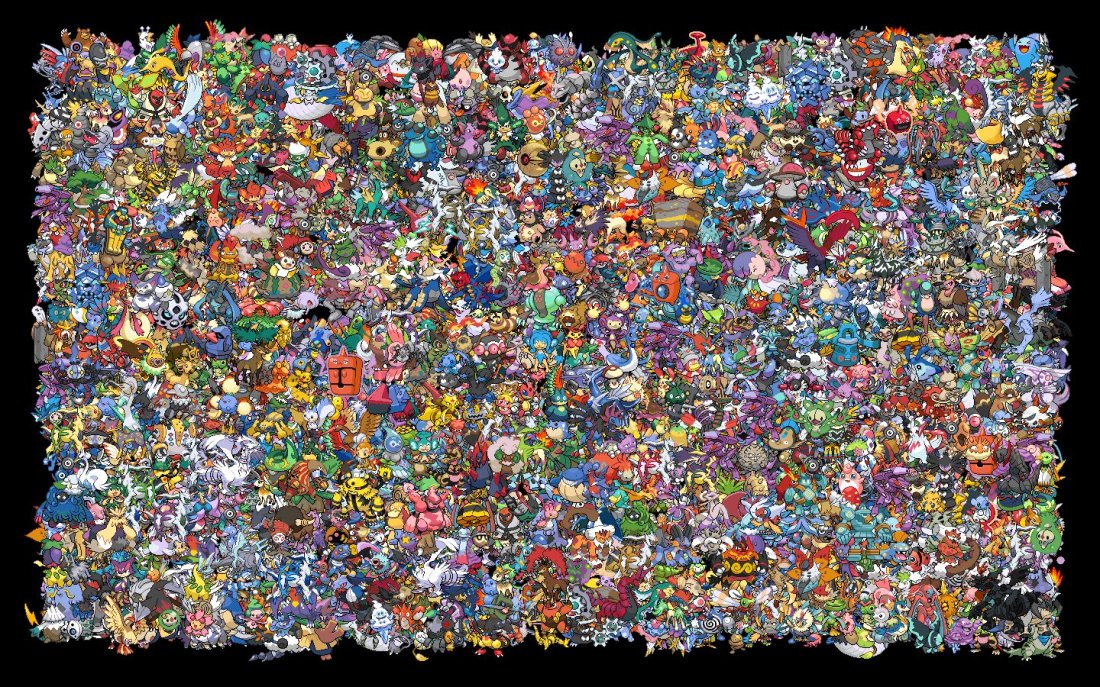
Do things look blurry enough up there? Out of focus? Can you not pick out very many individuals among the 807 or so you’ve acclimated, and eventually give up investing the time and effort in your favorite ones because there are just too many? Then you soon find yourself spread thin, after realizing the craze will fade out with time, and eventually stop playing the game so much as coasting through it out of obligation. Quite sad and pitifully anticlimactic, but it happens to all of us in this technologized world.
Oh, did you perhaps think I was talking about Pokemon? Good guess, but actually no; that in of itself was a lame trick of duality, a disconnection in mutual communication, for I was truly referring to human interactions. Human interaction, the thing which means both everything and nothing at all to us. On all planes and across all mediums, the human connection is but a flicker of what it once was. Sounds dismal, but I’m pumped, so let’s get radical!
Before I go any further with my own absurd thoughts, let’s start with the theoretical backbone, courtesy of Spinoza:
“P17: If the human body is affected with a mode that involves the nature of an external body, the human mind will regard the same external body as actually existing, or as present to it, until the body is affected by an affect that excludes the existence or presence of that body” (129).
de Spinoza, Benedict. A Spinoza Reader: The Ethics and Other Works. Ed. and Trans. by Edwin Curley. Princeton, NJ: Princeton University Press, 1994.
Barely makes a lick of sense out of context, doesn’t it? The importance of P17 is that it feeds into the next several propositions in Spinoza’s piece, growing from the conception of God’s being rooted in the idea of thinking and our own ability to think. But that importance remains solely within Spinoza’s work, because my argument is about human connections. I know this will be a rare exception, more so because I haven’t the space rather than because I’m not able to include it into my rationale, but I won’t be mentioning God much here. A rarity, just this once.
Instead, taking Spinoza’s theory out of context, consider the “external body” as having a direct connection to the human body. It is a body in of itself that we are recognizing, and we do not reject or accept it wholly, but, since it is a body, we reject or accept pieces of it that are communicated to us through its own conception of reality. Now, here’s the tricky part: consider that this “external body” is not so much acting on its own as it is absorbing and reflecting the realities that interact with it, thus becoming an artificial body, but nevertheless sharing the same reality as the one who claims it as their possession.
I think I gave away the culprit with terms like “artificial” and “possession”: when it comes to destroying human connectivity, I speak of social technologies, of course! But not in the way you’d expect, so do please hear me out.
Now, these external bodies–phones and computers, social networks and the like–function outside the human body. Hence “external.” However, there is a human body inextricably linked to every gadget and gizmo’s operation, every stream of data that remains personable to one single individual. A technological device is not an extension of the human body in this sense, but a separate body that categorizes the same reality shared by its owner. Indeed, they share the same reality, but not the same perception of reality. This is where the old-folks argument against technology comes into play, with anti-texting and anti-phone and “talk to your friends face-to-face, dammit!” sentiments finding full force. And I sympathize. I don’t empathize because I don’t have very many friends, so I don’t text or call or do squat very often.
This seemingly out-of-place self-pity is AHA! also another duality in disguise; the end of my post will give it a point.
Carrying onwards, the human body, in reacting to its own reality as perceived through the technological external body, will pick and choose what it desires to keep within that reality. That is the difference in perception; without the device, the human is far more limited in their control over human connection. The technology, instead of being an extension, categorizes the human experience and identity for both absorption and reflection, thus becoming a way to generate selective reality in an unnatural manner. Not because the technology itself is unnatural, but because the reality we are consequently left with is unnatural.
“I am quite aware that my cheerful endorsement of the post-anthropocentric turn may appear as over-enthusiastic and even triumphalist to some (Moore, 2011). As I said in the previous chapter, one’s relation to the posthuman is affected in the first place by one’s critical assessment of the human. My deep-seated anti-humanist leanings show in the glee with which I welcome the displacement of anthropos” (75).
Braidotti, Rosi. “Post-Anthroprocentrism: Life beyond the species.” The Posthuman. Oxford: Polity, 2013. 55-104
I must confess, I didn’t use this particular quote of Braidotti’s to take anything from it. I simply wanted it to sit here, marinating in the derisive “glee” of someone denouncing the very people they coexist with, as an example of the sudden deep-seated desire of the posthuman world to almost stop dealing with humans on a personal level. I don’t know if it is because it requires too much emotional investment and risk on their part or what, but the alternative is a shallow substitute. Everything becomes about scientific theory, about tribalism, about sexuality, about the world humanity inhabits and maintains, about the religious, philosophical, and political sects those humans hold fast to and argue about which one group is dominant. Group. Always the group. The post-human is so desirous of wiping out the individual, it never realizes that aim is but pipe dream; you can’t do what’s already been done.
The individual no longer exists. I’ll say it again: the individual no longer exists. With technology at our finger tips, the problem posed to human connectivity isn’t so much the deafness of the screen through which we communicate. It is, infuriatingly enough, the fact that we can too easily hyperconnect. And by hyperconnecting, the damage is twofold. First, interactions are more informed than they should be. Second, and much worse, interactions are more often than they should be.
“This means by extension that sexuality is a force, or constitutive element, that is capable of deterritorializing gender identity and institutions (Braidotti, 1994)” (99).
Braidotti, Rosi. “Post-Anthroprocentrism: Life beyond the species.” The Posthuman. Oxford: Polity, 2013. 55-104
The fact of the matter is that human ontology is built upon epistemology; the desire to learn, to know, to understand, is the whole driving force behind human life. It is why people are constantly searching for happiness, purpose, the answers to secrets, the cures to ailments. It’s why melancholy is such a dangerous thing, and the only reason it hasn’t afflicted us as much as Shakespeare’s plays is because we have plenty of distractions. Technology being one. Sexuality being another. Sexuality, a way of understanding the vulnerability and feelings of another and accommodate those feelings to meet in the middle, has been reduced to a “force” meant to “deterritorialize.” While Braidotti is dead-set on making it clear the institutions being broken down are the “capitalist, patriarchal” forces that supposedly keep women’s status frozen as a commodity, I counteract that sexuality has instead dissolved and replaced love.
Allow me provide a personal anecdote for example, just one of many possibilities that I could provide. You see, my first kiss, my first non-stage kiss, was my junior year of university. So, a year and a half ago, when I was studying abroad in London. It began, as I have said before, with a desire to know; my friend had treated her rudely at the club fair, and I reprimanded him, listened to her whole explanation, and told her I would look further into her club if I had time (which I had already decided I did not). However, that mystical thing called “care,” something no one seems to have anymore, piqued her desire to know me. She got her chance to do so when she caught me at a club, though I couldn’t remember her until she reminded me, which then piqued my desire to know this romantically fantastic situation better.
Okay, Pagliaccio, what’s your point? Thank you for keeping me on track, audience, because the point right there is not self-evident. At least not until I tell you of a conversation we had when alone together, talking on the nature of love. Our minds were divided. She could not really pin love beyond a feeling, beyond mutual pleasure in company and touch, beyond security. I suggested that love is caring for and upholding someone to a higher place than yourself in all that you do, because you know that they would do the same for you, even to their own detriment. She argued that this was preposterous; to put someone above yourself is to lower your own estimation of yourself, hurting self-esteem and personal mental health. I thought that was ridiculous, but didn’t tell her so, and we remained in disagreement. But we grew closer for the time being in that, through the process of knowing each other through interaction, our communication was given value.
And that is what has happened to love via the “force” of sexuality; as humanistic as sexuality sounds, it is actually love that remains the humanist element, whereas sexuality is posthuman. The personal connection of love is lost, the melding of two individuals can no longer happen; this sounds odd, since the melding of individuals is actually the goal of posthumanism (albeit with greater scope and scale), but the reason love can’t be posthuman is that there are actually individuals to meld. The posthuman defines itself by its identity within groups, and is not a full individual when coming upon another individual who has done the same thing. Furthermore, both sides–if not upon initial contact, then immediately after–has a desire to know that lasts for but a split second. Only a split second, because their realities are shared over social technologies, and so there is no drive, no desire to understand and know the other person, almost as if they’ve spoiled the movie and are simply sticking around only to claim they’ve watched the whole thing. Instead, one takes into account their affiliations, and presumptuously connects all the dots from that leaping-off point. Rather than receive the satisfaction of learning about someone through interaction, the posthuman learns everything they can before interacting with another, and so the interaction is little more than self-serving because nothing can grow from the encounters but what the participants generate for their own gain.
Well, then, if people have no drive to understand one another, then why do they get into relationships? Excellent question, my audience, I’m so glad you’re engaging with me. The truth of the matter is a paradox; with minds thinking more like groups than individuals, the sensitivity to feelings are heightened. Feelings, then, become the only way to connect back to individuality, which then becomes extraordinarily selfish. The human body, both male and female, and consequently human relationships as a whole, become driven by pleasure, security (both emotional and intellectual), and distraction. No one becomes friends with someone they don’t expect to extract something from, and those who are friends find their relationships constantly jeopardized by different opinions or inconstant contact. Human beings are no longer human beings to other human beings, but a way through which one can stabilize their own identity and social proliferation. Relationships are now a commodity. The human being outside of the self, likewise, is now a commodity.
Speaking of proliferation, that is the second issue; too many cooks stirring reality in the virtual kitchen. Picking up my anecdote, my first kiss and I did not last very long. She broke four promises in a row to meet with me on different days, and then became angry with me when I asked her why she broke those promises, arguing that she had no obligations to me. That was basically the end of contact with her. But it is ridiculous to think that I am the only one this has happened to, as it has happened to me multiple times on multiple different occasions; people like to retract promises to invest their time. But does it matter? They lose one fix, another will slide in to fill its place. The value of human connection has gone down thanks to technology. It also happens in sexuality, too; repeated sexual contact, continually thinking you’ve fallen in “love” and out of “love” repeatedly, all for your own personal identification and stabilization, numbs you to real love.
Yes, human connection is actually a capitalist affair, at least in that it involves a supply-and-demand model. Think of the early rhetoricians: they had one chance every now and then to convince their audience in a public venue, and they might be lucky enough to receive another chance should they succeed. In those days, and even in the recent centuries, demand for human connection was high while supply for moments to connect were significantly lower. Now, however, we can contact whomever we want whenever we want for as long as we want to. And that ruins the whole experience.
Mamoru Oshii’s Ghost in the Shell deals with this insensitivity from technologization ever so subtly on the boat scene between Matoko Kusanagi and Batou. Kusanagi is, for the most part, completely synthetic. Batou, however, has only cybernetic eyes and a brain that can connect to the internet. While on the boat together, before Kusanagi’s nighttime speech about feeling human, Batou has his own little speech. However, whereas Kusanagi’s is strictly questioning herself and her place in the wider context of humanity, Batou’s inquiries are personal and epistemological, designed to understand Kusanagi and her concepts of fear better. Kusanagi is completely self-absorbed in her identity while in active communication; Batou is actually attempting a conversation, though Kusanagi responds flatly or with quips. We even witness Batou slightly flustered to see Kusanagi stripping, while she seems to have no qualms with leaving the door open. We do not see Kusanagi sexually active, but she is still far more cybernetic and self-absorbed in her identity than Batou; perhaps this is the connection between communicative numbness and hyperconnectivity through external technological bodies?
With those so-called “bodies,” so-called because I called them so, we have complete control over our community, and are therefore not limited to our supply of connections. Supply and demand of human interaction are thereby limitless, or at least controlled by the initiator. Without much surprise, human relationships (real, genuine, epistemological human relationships), have lost tremendous value, especially when we can now include as many people as we can reach through technological devices to bring satisfaction, security, or pleasure to ourselves. But only ourselves; we are compromised if our co-connectors don’t offer anything useful to our own psychological, emotional, or social stability. The human connection is no longer an expected and hoped-for part of life; it has been commodified.
The irony of it all is that I am, naturally, conveying this to you, a third-party audience I might have never met, through a technological device that betrays a good deal of the intricacies that make me epistemologically attractive. For me, though, it is an act of desperation, especially after hearing my first kiss’ thoughts on what love is, obviously leaning towards the slope into sexuality, where personal identity takes presence over human connection. It’s like when I offhandedly mention my virginity in the hopes that I will draw other virgins; the type has become so rare, those not affected by technological posthuman communication, that I can only throw out some hefty critical words and hope they pique the interest of those who care.
In the posthuman social structure, by choosing to not engage in the commodification of human relationships, the chance for relationships is severed. The individual, in that moment of asserting individuality by refusing to accept any connection lacking an appreciation for the epistemological, loses all worth. It becomes another form of Spinoza’s “external body,” its individuality becoming the “affect that excludes the existence or presence of that body” (de Spinoza 129). In its absence from technological reality, the individual is likewise exiled from the social being’s personal reality, despite the fact that pursuing such relationships are the most rewarding and often last the longest. I don’t really have proof of this except for the sudden cry for the death of monogamy, I suppose because people get so bored with intimacy when they’re spread too thin and not deep enough.
My own experience living alone might also say something to this effect. Since I exist in an extremely isolated fashion, every little encounter with another individual receives my utmost care and attention, because that moment is the only moment I can count on. But, to most everyone else, its just another encounter in hundreds that week, and you’ll call me up or ignore me later if you want so this all doesn’t really matter in the scheme of things because we’ll always be connected and unveiled for judgment among the groups that designate the level of our relationship. The posthuman commodification of human connection has led to unhappiness, both within and without the system. So, kind of like Pokemon, I realized there was no reward in playing a pointless, reckless, unsatisfying game my whole life. Worst of all, you just end up wasting tons of time on digitized, data-fied creatures that don’t really exist in a tangible, interactive reality.
I’m no humanist, I promise, but posthumanism is going too far in changing the underlying structure of anthropocentric relationships (you can call this a move to the turbacentric). The difference between I and the posthumanist when arguing this change, though, is that I don’t need to convince the whole world to hear me. I think I’d be content if I knew just one other person was on the same page as me. Because then I’d be on the same page as them. Not in total agreement on every little thing, no, but on the same page. And that’s all you really need. But the technologized world is determined to erase that sort of personal co-dependence, and I don’t know how much hope is left for something that nobody even remembers.







 Morning's Early Dark